Dementia Care Through Compassionate Chaplaincy
There's a profound mystery at the heart of dementia ministry, one that connects directly to the paschal mystery of Christ's passion, death, and resurrection. Jesus on the cross experienced utter vulnerability, dependence, even a sense of abandonment.
HEALING
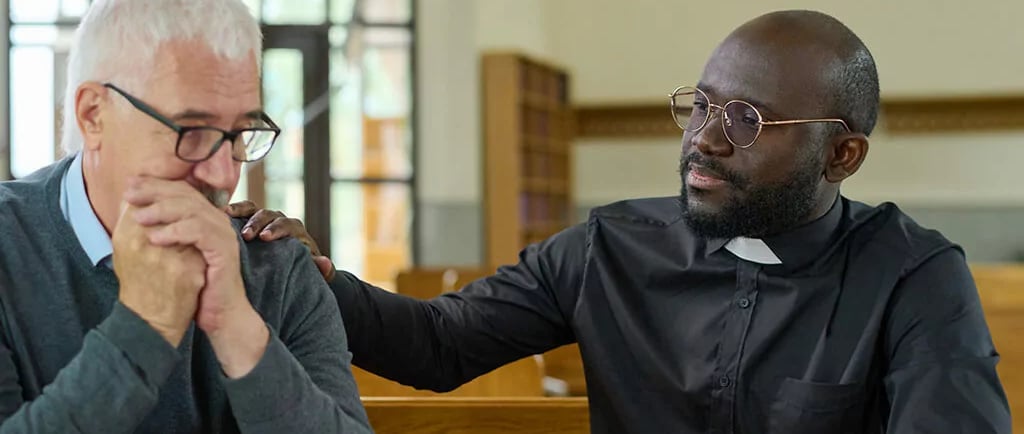
The Sacred Ministry of Presence: A Call to Transform Dementia Care Through Compassionate Chaplaincy
by Archbishop Felix Gibbins OSB Cam
In the quiet corridors of care homes, hospitals, and hospices across our nation, a profound ministry unfolds daily – one that demands both ancient wisdom and modern understanding. Dementia chaplaincy represents one of the most vital yet under-resourced areas of pastoral care in our contemporary Church. As our population ages and the prevalence of dementia continues to rise, the need for trained clergy and chaplains who can minister effectively to those with cognitive decline has never been more urgent. This isn't simply about visiting the elderly; it's about understanding the unique spiritual landscape of dementia care and meeting Christ in those who may no longer recognise us by name but who remain beloved children of God.
The reality is sobering yet sacred. Elderly care in residential settings, particularly for those experiencing dementia, requires a specialised approach that honours both the person's medical needs and their enduring spiritual identity. Modern breakthroughs in understanding dementia – from person-centred care approaches to insights about preserved emotional memory – must inform how we, as priests and chaplains, bring the sacraments and the comforting presence of the Church to these vulnerable members of our flock. This article explores not only how we minister to those with dementia but also how we support their families and the often-overlooked care staff who labour alongside us in this essential work.
Understanding Dementia: A Theological and Medical Perspective
Before we can minister effectively, we must first understand what we're ministering to. Dementia isn't simply 'forgetfulness' or 'confusion' – it's a progressive neurological condition that affects memory, thinking, behaviour, and the ability to perform everyday activities. The most common form is Alzheimer's disease, but vascular dementia, Lewy body dementia, and frontotemporal dementia each present their own challenges and characteristics.
Dr Christine Bryden, herself living with dementia, has written powerfully about the spiritual dimensions of her experience: 'I may not remember what I had for breakfast, but I remember the feeling of being loved.' This insight is crucial for chaplaincy. Whilst dementia affects cognitive function, research consistently shows that emotional and spiritual capacities often remain remarkably intact, sometimes even heightened. The person before you may not recall your name or yesterday's visit, but they can still experience the peace of prayer, the comfort of the Eucharist, and the assurance of God's presence.
From a Catholic theological perspective, we must remember that the imago Dei – the image of God – doesn't diminish with cognitive decline. As the Catechism reminds us, 'Every human being, from conception to natural death, has a right to life and to be treated with dignity' (CCC 2319). Saint John Paul II, himself facing the challenges of Parkinson's disease in his later years, demonstrated through his own witness that human dignity persists regardless of our physical or cognitive state. He wrote in Salvifici Doloris that 'suffering... is a call to manifest the moral greatness of man, his spiritual maturity.'
"The greatest disease in the West today is not TB or leprosy; it is being unwanted, unloved, and uncared for. We can cure physical diseases with medicine, but the only cure for loneliness, despair, and hopelessness is love." – Saint Teresa of Calcutta
This understanding must ground all our pastoral work. When we approach someone with dementia, we're not ministering to a diminished person but to a complete human being whose way of experiencing and expressing their faith has changed. Our ministry must adapt to meet them where they are, not where they once were.
The Unique Challenges of Dementia Chaplaincy
Let's be honest about the challenges we face. Ministering to those with dementia can be profoundly difficult, even for experienced clergy. You may visit week after week only to be greeted as a stranger each time. You might hear the same story repeated twenty times in one conversation. You could encounter agitation, confusion, or even aggression. The person you're visiting might be unable to participate in the Mass in the ways they once did, unable to make a proper confession, or unable to receive Holy Communion safely.
Dr Jennifer Bute, a retired GP who was diagnosed with dementia and later became a prominent advocate for dementia-friendly worship, notes: 'People with dementia are not giving up on life – they're finding new ways to live it. The Church needs to walk alongside us in those new ways.' This requires us to reconsider some of our assumptions about what 'proper' ministry looks like.
The Ancient Apostolic Catholic Church's canons acknowledge these realities. Canon 999 states that 'those who may lawfully receive the anointing are: the baptised who are seriously ill from sickness or old age; those about to undergo serious surgery; and those whose health is seriously impaired by disease or frailty.' This explicitly includes those whose health is impaired by dementia. Canon 1001 instructs that 'pastors and priests should be attentive to the sick, visiting them, providing the sacrament when needed, and arranging for appropriate pastoral care. They should prepare the person and their family spiritually and explain the sacrament's meaning.'
But here's the crucial question: how do we explain a sacrament's meaning to someone who may not remember the explanation five minutes later? How do we prepare someone spiritually when they're living in a perpetual present moment? The answer lies in understanding that preparation and understanding operate on multiple levels. The Holy Spirit doesn't require our cognitive comprehension to work in our hearts. God's grace doesn't depend on our ability to articulate theology.
Consider the example of Our Lord's own ministry. When He healed the demoniac, He didn't wait for a coherent confession of faith – He responded to the man's immediate need and distress. When He called His disciples, they didn't fully understand what they were being called to; their understanding grew over time through relationship and experience. Similarly, in dementia chaplaincy, we recognise that relationship, presence, and consistent care communicate God's love in ways that transcend words.
A Five-Point Pastoral Plan: Integrating Modern Understanding with Ancient Faith
Drawing on both contemporary dementia care research and our rich Catholic tradition, I propose a five-point plan for priests and chaplains working in care homes, hospitals, and hospices. This framework incorporates modern breakthroughs in understanding dementia whilst remaining firmly rooted in our sacramental theology and pastoral practice.
1. Embrace Person-Centred Pastoral Care
The late Professor Tom Kitwood revolutionised dementia care with his concept of 'person-centred care', which emphasises the individual's personhood over their diagnosis. As chaplains, we must adopt this approach spiritually. This means:
Learning the person's spiritual history before dementia advanced. Speak with family members to understand their devotional practices, favourite prayers, meaningful hymns, and significant moments in their faith journey. Did they have a particular devotion to Our Lady? Were they daily communicants? Did they serve as Extraordinary Ministers of Holy Communion?
Adapting your approach to their current state. If someone is in the early stages of dementia, they may benefit from familiar liturgical structures and can participate in Mass normally. In moderate stages, shorter prayers, familiar hymns, and tactile elements (rosary beads, holy cards, blessed candles) become crucial. In advanced stages, your mere presence, gentle touch, and simple blessings may constitute the entirety of your ministry.
Recognising that personhood includes emotional and spiritual dimensions that persist. Research by Professor Linda Clare at the University of Exeter has demonstrated that people with dementia maintain a sense of self and relationship even when memory fails. Use this knowledge to build genuine connection: 'Good morning, Margaret. I'm Father Tom from St Mary's. I'm here to pray with you today. I can see from this beautiful rosary on your table that Our Lady is important to you.'
This approach honours Canon 1006's requirement that 'anointings must be administered with charity, respect, and sensitivity to the sick and their families, preserving dignity and pastoral discretion.' Person-centred care is preserving dignity – it's seeing Christ in the person before you, regardless of their current cognitive state.
2. Utilise Multi-Sensory Ministry
One of the most significant breakthroughs in dementia care has been understanding the power of sensory engagement. Whilst explicit memory deteriorates, implicit memory – including emotional memory and sensory associations – often remains remarkably intact. Dr Glenn Smith, a neuropsychologist at the Mayo Clinic, notes: 'Even when people can't remember specific events, they can still respond to familiar sensations, smells, and sounds that evoke comfort and security.'
For Catholic chaplaincy, this is profoundly important because our faith is a sensory faith. We have incense, holy water, candles, sacred images, the physical touch of anointing, the taste of the Eucharist, and the sound of familiar prayers and hymns. Use these intentionally:
Scent: Whilst you may not be able to use incense in a care home, you could use holy oil for anointing (Canons 1000-1001). The familiar scent of blessed oil – particularly the Oil of the Sick – can trigger deep spiritual memories and provide comfort.
Touch: The laying on of hands, the sign of the cross traced on the forehead, holding someone's hand during prayer – these physical gestures communicate God's love in ways that transcend language. Always approach gently and with permission (even if that permission is non-verbal assent).
Sound: Familiar hymns and prayers can reach people even in advanced dementia. The 'Our Father', 'Hail Mary', and 'Glory Be' are often retained long after other memories fade. Traditional Catholic hymns like 'Ave Maria', 'Immaculate Mary', or 'Soul of My Saviour' may spark recognition and participation.
Sight: Religious images, crucifixes, icons, and holy cards provide visual focal points for prayer and meditation. Don't underestimate the power of simply sitting with someone in front of a crucifix or icon of Our Lady, even if few words are exchanged.
Taste: The Eucharist is perhaps the most profound sensory encounter in our faith. For those who can still safely swallow, receiving Holy Communion connects them to the entire Church, to Christ Himself, and to their lifelong practice of faith. Canon 921 specifically addresses this: 'The faithful in danger of death should be strengthened by receiving Communion as Viaticum... Even if they have already received Communion that day, they may receive it again as Viaticum.'
The beauty of this approach is that it doesn't require the person to 'perform' their faith cognitively. Their body, their senses, their heart can still pray even when their mind struggles to follow along. As Saint Augustine wrote: 'You have made us for yourself, O Lord, and our heart is restless until it rests in you.' That restlessness, that yearning for God, doesn't disappear with dementia – it simply needs different pathways for expression.
3. Practice Validation and Presence
One of the most important concepts in dementia care is 'validation therapy', developed by Naomi Feil. Rather than correcting someone with dementia when they're confused about time, place, or person, validation involves entering their reality and responding to the emotion beneath their words. Dr Feil explains: 'When we validate, we recognise that behind the confusion is a real human emotion that deserves acknowledgement.'
For chaplains, this means several things practically:
If someone believes they need to go to Mass (when in fact it's Tuesday afternoon and they're in a care home), don't correct them by saying 'No, you're confused, Mass was Sunday and you're not at church.' Instead, you might say: 'I can see that going to Mass is important to you. Would you like to pray with me now? We can say the prayers of the Mass together right here.'
If someone insists they need to confess sins from decades ago (which they may have already confessed countless times), hear them. The Sacrament of Reconciliation doesn't lose its efficacy through repetition, and their need to confess speaks to a deep spiritual anxiety that deserves pastoral response, not dismissal.
If someone is distressed because they believe a deceased loved one is waiting for them or needs them, respond to the emotion (grief, worry, love) rather than the factual error. You might pray together for that person's soul, entrusting them to God's mercy and love.
This approach reflects the truth that presence is more important than precision. Your primary role as a chaplain isn't to correct confusion but to be Christ's presence in the midst of it. Jesus didn't quiz the thief on the cross about his theological understanding before promising him paradise. He recognised genuine need and responded with love.
"Be still, and know that I am God" (Psalm 46:10). Sometimes, the greatest gift we can offer is simply to be still alongside someone, to hold their hand in silence, to witness their struggles without trying to fix them. This is holy work.
4. Establish Routines and Rituals
Research consistently shows that people with dementia benefit enormously from routine and ritual. Dr Mary Mittelman, Director of Psychosocial Research at NYU Langone Medical Center's Aging and Dementia Research Center, notes: 'Predictable patterns and familiar rituals provide a framework that helps people with dementia feel secure and maintain connection to their identity.'
As Catholics, we're blessed to have a faith steeped in ritual and routine. The liturgical calendar, the structure of the Mass, the rhythm of daily prayer – these can all be adapted for dementia chaplaincy:
Visit on the same day and at the same time each week if possible. Even if the person doesn't explicitly remember your last visit, there can be a sense of familiarity when you arrive: 'Father comes on Thursday afternoons.'
Follow a consistent pattern in your visits. Perhaps you always begin with the Sign of the Cross, pray a decade of the Rosary, read a brief Scripture passage (the same one repeatedly can be comforting), and end with a blessing. This structure provides security.
Mark significant liturgical seasons visibly. Bring palm crosses for Palm Sunday, blessed candles for Candlemas, ashes for Ash Wednesday. These tangible signs connect the person to the Church's liturgical life and can spark memories and participation.
Consider arranging regular communal services in the care home if there are multiple Catholic residents. A weekly or monthly Mass, even simplified, allows residents to participate in the Church's central act of worship. Canon 566 grants chaplains specific faculties to hear confessions, preach, administer Viaticum, and anoint the sick within their ministry setting.
The rhythm of ritual communicates stability and continuity in a world that, for someone with dementia, can feel chaotic and unpredictable. In providing this stability, we reflect God's own faithfulness – He who is 'the same yesterday and today and forever' (Hebrews 13:8).
5. Maintain Sacramental Integrity with Pastoral Flexibility
This final point addresses what is perhaps the most theologically complex aspect of dementia chaplaincy: how do we maintain the integrity of the sacraments when the person receiving them may have significantly limited capacity for understanding and consent?
The traditional Catholic moral theology employs the concept of habitual intention – the idea that someone who, when they had full capacity, regularly received the sacraments and desired to continue doing so, maintains that intention even when they can no longer explicitly express it. This principle allows us to:
Continue to bring Holy Communion to someone who was a regular communicant before dementia advanced, even if they can no longer explicitly request it, provided they don't refuse it and can safely swallow.
Administer the Anointing of the Sick to someone in advanced dementia, understanding that whilst they may not comprehend the theological significance of what's happening, their baptismal identity and lifelong faith constitute a form of ongoing consent.
Offer the Sacrament of Reconciliation, adapting the form as needed. If someone cannot make a detailed confession but expresses general sorrow for sin (even simply by saying 'sorry' or appearing distressed), you can offer absolution using the Church's provisions for those in danger of death or with limited capacity.
However, pastoral flexibility must be balanced with genuine respect for the person's dignity and autonomy. If someone actively refuses a sacrament (by turning away, pushing your hand away, saying 'no', showing distress), that refusal must be honoured. The sacraments are gifts, not impositions. Similarly, if someone can no longer safely swallow, attempting to administer Holy Communion could cause harm; in such cases, a spiritual communion prayer or simply a blessing may be more appropriate.
Canon 1007 reminds us that 'pastors should cooperate with health-care providers for the good of the sick, observing confidentiality and ensuring pastoral care complements medical treatment..' This means consulting with nursing staff about whether someone can safely receive Holy Communion, working with occupational therapists about the best times and environments for pastoral visits, and respecting care plans that may restrict visits during certain times for medical reasons.
Ministering to the Circle: Family and Carers
When we minister to someone with dementia, we never minister only to that individual. Every person with dementia exists within a network of relationships: family members, friends, and professional carers. These people, too, need pastoral care, perhaps even more urgently than the person with dementia themselves.
Supporting Families
The families of people with dementia often experience what's been called 'ambiguous loss' – their loved one is physically present but psychologically absent, or at least changed. Professor Pauline Boss, who coined this term, describes it as 'a loss that remains unclear' and notes that it can be more difficult to process than death itself because there's no closure, no funeral, no clear end point.
As chaplains, we must acknowledge this unique grief:
Validate their sorrow. It's not disloyal to grieve for the person your mother was whilst she still lives. It's honest. Jesus himself wept at Lazarus' tomb even though He knew He would raise him. Grief is a natural response to loss, and dementia involves profound losses.
Provide space for confession and absolution. Many family members carry guilt: guilt over care home placement, guilt over feeling relieved when visits end, guilt over moments of impatience or frustration. Hear these confessions with compassion. Remind them that they're doing their best in an impossibly difficult situation.
Offer practical spiritual resources. Perhaps a decade of the Rosary specifically for caregivers. A bookmark with Psalm 23 or the Prayer to Saint Joseph, patron of carers. A blessing for those caring for elderly parents.
Help them maintain spiritual connection with their loved one. Teach them simple prayers they can say together, even if no conversation is possible. Explain that sitting in silence, holding hands, can be prayer. Encourage them to bring in familiar religious items from home: a beloved crucifix, a picture of a saint, wedding rosary beads.
Prepare them for death. This is perhaps our most important role. Many families struggle with questions about end-of-life care, particularly around tube feeding, hospitalisation, and the administration of Viaticum. Canon 922 states: 'Viaticum should not be delayed until the person is at the point of death, but given while they are still able to receive it with devotion.' Help families understand what the Church teaches about proportionate care, about the dignity of dying, and about our hope in the resurrection.
"Cast all your anxiety on him, because he cares for you" (1 Peter 5:7). Remind families that God doesn't expect them to bear this burden alone. Prayer is not weakness – it's the acknowledgement of our dependence on divine grace.
Supporting Care Staff
This is the pastoral dimension most often overlooked, yet it's crucial. The nurses, care assistants, activities coordinators, and domestic staff in care homes and hospitals witness suffering daily. They lift, wash, feed, and comfort people with dementia through confusion, agitation, and decline. They form attachments to residents and then experience loss when those residents die. This work takes an enormous emotional and spiritual toll.
Dr Caroline Nicholson, Senior Research Fellow at King's College London, has researched the experiences of care home staff during COVID-19 and beyond. She notes: 'Care staff often describe their work as a calling, not just a job. They need spiritual and emotional support to sustain that calling, but they rarely receive it.'
As chaplains, we can and must minister to care staff:
Be visible and available. Don't rush in to visit a resident and rush out again. Linger. Have a cup of tea in the staff room. Let it be known that you're available to talk, to listen, to pray with staff members.
Acknowledge their work as ministry. Whether or not they're Catholic or even religious, care workers are doing Christ's work. Matthew 25:40 applies here: 'Whatever you did for one of the least of these brothers and sisters of mine, you did for me.' Tell them you see their compassion, their patience, their dignity in the face of difficulty.
Offer rituals marking transitions. When a resident dies (especially someone who's been in the home for years), hold a brief memorial service or blessing. Staff need permission to grieve. In some care homes, chaplains have established simple rituals: lighting a candle, saying a prayer, acknowledging the person who's been lost and the staff who cared for them.
Provide spiritual first aid during crises. When a resident becomes violent, when a death is particularly traumatic, when staff witness something that shakes them – be available. Not to give answers (because often there aren't any) but to witness their distress and assure them of God's presence even in darkness.
Advocate for their wellbeing. If you notice signs of burnout, moral injury, or compassion fatigue, speak up. Care homes often operate on thin margins with inadequate staffing. Whilst you can't fix systemic issues, you can raise concerns with management and ensure that staff welfare is taken seriously.
Canon 568 states: 'Where possible, chaplains should serve those unable to access ordinary pastoral care, such as migrants, exiles, refugees, nomads and seafarers.' I would argue that care home staff, especially those from migrant backgrounds working in low-paid, emotionally demanding roles, fall within this category. They often can't access ordinary pastoral care because they're working when churches hold services. They may be from different faith traditions or none. But they're doing sacred work, and they need spiritual support.
The Urgent Need for Clergy Training
Everything I've outlined above requires specific knowledge and skills that most priests and deacons simply don't receive in seminary formation. We're taught sacramental theology, homiletics, canon law, pastoral counselling – all essential. But we're rarely taught about neurodegenerative diseases, about the specific communication techniques needed for dementia care, about the complex ethical questions that arise at the intersection of cognitive decline and sacramental validity.
This must change. The statistics are stark: by 2025, over one million people in the UK will be living with dementia. Many of them will be Catholic, and all of them will need pastoral care. We cannot afford to have clergy who are uncomfortable or unprepared for this ministry.
I propose that dioceses and religious communities establish mandatory training in dementia chaplaincy, covering:
Medical Understanding: Basic neuroscience of dementia, types of dementia, progression patterns, common symptoms, and what to expect at each stage.
Communication Skills: Validation therapy, managing challenging behaviours, non-verbal communication, and person-centred language.
Theological Reflection: Considering questions of personhood, suffering, sacramental validity, end-of-life ethics, and the theology of presence through the lens of dementia care.
Practical Ministry Skills: Adapting liturgy, creating meaningful rituals, working with families and care staff, and providing spiritual care in institutional settings.
Self-Care and Supervision: Recognising vicarious trauma, establishing boundaries, seeking support, and maintaining one's own spiritual health whilst ministering to others.
This training should include both academic components (perhaps a short course or series of webinars) and practical placements where clergy spend time in care homes, shadow experienced chaplains, and practice dementia-friendly ministry under supervision.
Furthermore, we need ongoing formation. Dementia research is advancing rapidly; what we know about best practices today may be refined or revised tomorrow. Regular continuing education ensures that clergy remain current in their understanding and skilled in their practice.
For Loved Ones: Using Space, Silence, and Presence
Many family members and friends feel helpless when visiting someone with dementia. They don't know what to say, what to do, how to connect. The silence can feel awkward, the lack of conversation distressing. I want to speak directly to these loved ones and offer some contemplative suggestions.
First, understand that silence is not emptiness. In our culture, we're uncomfortable with quiet. We feel we must fill every moment with words, with activity, with stimulation. But in the contemplative tradition – going back to the Desert Fathers and Mothers, through the Carthusians, to contemporary teachers like Thomas Merton – silence is understood as a space where God speaks most clearly.
When you sit with someone who has dementia, you have an opportunity to practice contemplative presence. This means:
Being fully present, not distracted by your phone or your worries about what to say next. Just be there.
Accepting that you don't need to entertain or educate or stimulate. Your presence itself is the gift.
Holding their hand (if they're comfortable with touch) and simply being together. You might pray silently. You might notice their breathing and synchronise yours with theirs. You might look out the window together and watch the birds.
Using the space itself as a place of encounter with God. Bring a candle (if permitted) and light it together. Place a small icon or holy card where they can see it. Create a sacred space even within the clinical environment of a care home.
Praying simple, repetitive prayers together. The 'Jesus Prayer' ('Lord Jesus Christ, Son of God, have mercy on me, a sinner') can be said slowly, repeatedly, becoming almost like a heartbeat. The Rosary, said gently and without pressure to finish, offers rhythm and comfort.
Remember the story of Mary and Martha (Luke 10:38-42). Martha was busy serving, doing, working. Mary sat at Jesus' feet and listened. Jesus said Mary had chosen 'the better part'. When you visit someone with dementia, you're called to be Mary, not Martha. To sit, to be, to listen (even if what you're hearing is confused or repetitive or silent).
Your loved one is teaching you something profound about the nature of love and relationship. In his later years, when Parkinson's disease limited his speech and movement, Pope John Paul II demonstrated that presence, not performance, is what matters. His silent suffering became a powerful witness. Similarly, your loved one with dementia is showing you that love doesn't depend on eloquent conversation or shared activities. Love is simply being there, faithfully, tenderly, patiently.
"The Lord is near to the brokenhearted, and saves the crushed in spirit" (Psalm 34:18). God is present in that room with you and your loved one. Trust in that presence, even when you can't feel it.
Conclusion: The Crucified Christ in Those with Dementia
There's a profound mystery at the heart of dementia ministry, one that connects directly to the paschal mystery of Christ's passion, death, and resurrection. Jesus on the cross experienced utter vulnerability, dependence, even a sense of abandonment ('My God, my God, why have you forsaken me?'). He was unable to care for Himself, reliant on others for the smallest mercies.
When we minister to someone with dementia, we encounter that same vulnerability, that same dependence. We meet Christ crucified in the person who no longer recognises their own child, who repeats the same question endlessly, who sometimes lashes out in fear and confusion. This is not diminishment; this is revelation.
Saint Jean Vanier, founder of the L'Arche communities for people with intellectual disabilities, wrote extensively about the gifts offered by those society considers weak or incapacitated. He observed: 'Those who are weak transform those who are strong by calling forth the qualities of the human heart: compassion, patience, kindness, understanding, loyalty, faithfulness.' The same is true for those with dementia. They call us to become more fully human, more fully Christian.
Canon 564 defines a chaplain as 'a chaplain is a priest entrusted in a stable way with the pastoral care (in whole or in part) of a specific community or group, exercising that care under universal and particular law.'. To be entrusted with the care of those with dementia – and their families and carers – is a sacred trust. It demands everything I've outlined in this article: medical understanding, communication skills, theological reflection, practical adaptability, and above all, a deep well of compassion.
But it also offers something in return. In ministering to those with dementia, we learn profound lessons about what truly matters. We discover that relationship transcends cognition, that love persists beyond memory, that the soul's capacity for God doesn't depend on our mental faculties. We are humbled, challenged, and changed.
This, then, is my call to arms for the Church: let us recognise dementia chaplaincy as the essential ministry it is. Let us train our clergy properly. Let us support families and carers pastorally. Let us bring the fullness of our sacramental life to those who can no longer come to us. Let us be present, faithful, creative, and courageous in this work.
And let us remember the promise of Christ: 'I was sick and you visited me' (Matthew 25:36). In visiting those with dementia, in bringing them the comfort of the sacraments and the assurance of the Church's love, we visit Christ Himself. There is no higher calling, no more sacred work.
May we have the grace to see Christ in those with dementia. May we have the courage to be Christ for them. And may we trust that, in this ministry, we are participating in the very life of God, who loves each person – regardless of their cognitive capacity – with infinite, unchanging, perfect love. Amen.
Recommended Resources for Further Reading
Books:
Bryden, C. (2015). Dancing with Dementia. London: Jessica Kingsley Publishers.
Swinton, J. (2012). Dementia: Living in the Memories of God. Grand Rapids: Eerdmans.
Kitwood, T. (1997). Dementia Reconsidered: The Person Comes First. Buckingham: Open University Press.
Vanier, J. (1998). Becoming Human. London: Darton, Longman and Todd.
Organisations:
Alzheimer's Society UK (www.alzheimers.org.uk) – Comprehensive resources on dementia care
Dementia UK (www.dementiauk.org) – Support for families and professional carers
Catholic Association of Performing Arts (www.capa.org.uk) – Resources for dementia-friendly worship
Training Opportunities:
Contact your diocesan office to enquire about dementia awareness training for clergy and lay ministers.
The Healthcare Chaplaincy Council offers CPD courses in dementia chaplaincy.
For further information about chaplaincy training in the Ancient Apostolic Catholic Church, please contact the Office of the Primate.
Ancient Apostolic Catholic Church
Embracing faith, inclusion, and compassionate service together.
ST THOMAS AQUINAS SEMINARY
© 2026. All rights reserved
QUICK LINKS
Prayer Requests
Mass Intentions
Requiem Mass
Contact Us
Pilgrim Chronicles
ORDER OF ST DAVID
ORDER OF THE KNIGHTS OF ST MARY OF BETHLEHEM