Holy Orders and the Male Priesthood
We invite you to discover, belong, and journey with us in faith. Welcome home to the Ancient Apostolic Catholic Church—where tradition meets mission, and community flourishes.
Responding to Objections
“Jesus was simply conforming to his culture.”
This objection fails to account for Christ’s consistent willingness to transgress cultural norms regarding women. He spoke with women publicly, taught them directly, accepted their ministry, and entrusted them with the first proclamation of the Resurrection. If Jesus had wished to ordain women, no cultural constraint would have prevented him.
“Galatians 3:28 abolishes distinctions between male and female.”
Paul’s declaration that “there is neither male nor female; for you are all one in Christ Jesus” refers to the universal call to salvation and divine filiation, not to ministerial offices. The same Paul who wrote Galatians also wrote the instructions in 1 Timothy and 1 Corinthians regarding the ordering of ministry.
“The early Church had women leaders.”
Scripture and patristic literature attest to the vital role of women in the early Church: as deaconesses, widows, virgins, teachers of other women, patronesses of house churches, and co-workers in the Gospel. However, the evidence for women exercising the priestly or episcopal office within orthodox communities is vanishingly thin. The instances that are sometimes cited come from groups already identified as heretical on other grounds.
“This teaching reflects outdated views about women.”
The Church distinguishes between the cultural packaging in which a teaching may historically have been presented and the substance of the teaching itself. Some Fathers and medieval theologians did hold views about women’s nature that we now recognise as erroneous. However, the conclusion that ordination is reserved to men does not depend upon those premises. It rests upon the sovereign choice of Christ, the apostolic tradition, and the sacramental theology of representation.
“Excluding women from ordination is unjust discrimination.”
Justice requires treating equals equally. However, equality of dignity does not entail identity of function. Men and women are equally created in God’s image, equally called to holiness, equally destined for eternal life. They are not, however, interchangeable in every respect. The ministerial priesthood is not a right to which anyone can lay claim; it is a gift and calling that Christ bestows according to his wisdom.
Introduction
The Ancient Apostolic Catholic Church (AACC) stands in a distinctive position within the Independent Catholic Movement. Whilst the majority of Independent Catholic jurisdictions have embraced the ordination of women to the diaconate, presbyterate, and episcopate, the AACC has, through its Synod of Bishops, determined to maintain the apostolic discipline of ordaining only men to these sacred offices. This decision, enshrined in our Declaration, Foundational Principles, and Canons, is not a matter of cultural preference or institutional inertia. Rather, it flows from a careful consideration of Sacred Scripture, the witness of the Church Fathers, the teaching of the Ecumenical Councils, the Doctors of the Church, and the consistent magisterial pronouncements of the Catholic tradition.
Here you will find the AACC’s theological reasoning that underpins our position. In doing so, we acknowledge that this teaching is countercultural, both within contemporary society and within much of the Independent Catholic Movement itself. Nevertheless, we are persuaded that fidelity to the apostolic deposit requires us to uphold this discipline as a matter of divine constitution rather than mere ecclesiastical policy.
The Scriptural Foundation
The Sovereign Choice of Christ
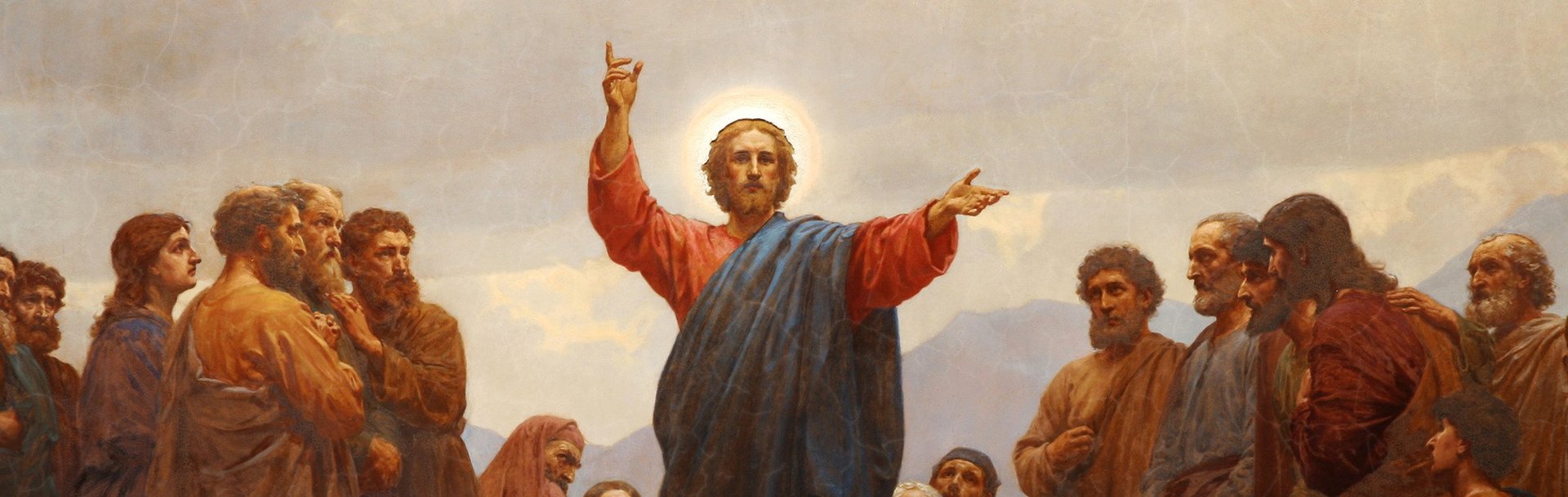
The foundation of the Church’s discipline regarding ordination rests upon the free and sovereign action of our Lord Jesus Christ. When Christ established the sacrament of Holy Orders, he did so by calling twelve men to serve as his Apostles. This choice was neither arbitrary nor culturally conditioned; it was a deliberate act of divine will.
St Luke records that before choosing the Twelve, Jesus “went out to the mountain to pray; and all night he continued in prayer to God. And when it was day, he called his disciples, and chose from them twelve, whom he named.” (Lk 6:12-13). The gravity of this decision is underscored by the preceding night of prayer. Our Lord was not constrained by cultural expectations; throughout his ministry, he consistently transgressed social norms regarding women. He spoke publicly with the Samaritan woman at the well (Jn 4:27), defended the woman caught in adultery (Jn 8:3-11), accepted the ministry of women who travelled with him (Lk 8:1-3), and first revealed himself as the Risen Lord to women (Mt 28:1-10; Jn 20:11-18).
As St John Paul II observed in Mulieris Dignitatem, “In calling only men as his Apostles, Christ acted in a completely free and sovereign manner. In doing so, he exercised the same freedom with which, in all his behaviour, he emphasised the dignity and the vocation of women, without conforming to the prevailing customs and to the traditions sanctioned by the legislation of the time.”
The Pauline Witness
The Apostle Paul, writing under divine inspiration, provides explicit instruction regarding the ordering of ministry. In his First Letter to Timothy, he writes: “I do not permit a woman to teach or to have authority over a man; she must be silent” (1 Tim 2:12). Crucially, Paul grounds this instruction not in cultural convention but in the order of creation: “For Adam was formed first, then Eve” (1 Tim 2:13).
Similarly, in his First Letter to the Corinthians, Paul instructs: “As in all the churches of the saints, the women should keep silence in the churches. For they are not permitted to speak, but should be subordinate, as even the law says” (1 Cor 14:33-34). The appeal to “all the churches” indicates that this was not a local accommodation but universal apostolic practice.
These texts must be read alongside Paul’s acknowledgment of women’s participation in prayer and prophecy (1 Cor 11:5) and his commendation of women co-workers in the Gospel (Rom 16:1-3; Phil 4:2-3). The distinction is clear: women participated vitally in the life of the early Church, but the authoritative teaching office and governance of the community were reserved to men.
The Symbolism of the Twelve
The number twelve is laden with theological significance. Christ chose twelve Apostles to correspond with the twelve tribes of Israel, signifying that his ministry constitutes the eschatological renewal of the people of God. As Christ himself declared, “Truly, I say to you, in the new world, when the Son of man shall sit on his glorious throne, you who have followed me will also sit on twelve thrones, judging the twelve tribes of Israel” (Mt 19:28).
This symbolic correspondence requires male ministers. Just as the twelve patriarchs who gave their names to the tribes were men, so the twelve Apostles who form the foundation of the New Israel are men. The ministerial priesthood, which participates in the apostolic office, perpetuates this symbolic structure.
The Patristic Witness
The Unanimous Voice of the Fathers
The Church Fathers bear unanimous testimony against the ordination of women to the presbyterate and episcopate. This consensus is particularly striking given the diversity of cultural contexts, theological emphases, and pastoral situations represented by these witnesses.
Tertullian (c. 155-240), writing in North Africa, provides one of the earliest explicit statements: “It is not permitted to a woman to speak in church, nor to teach, nor to baptise, nor to offer, nor to claim for herself any function proper to a man, least of all the office of priest” (On the Veiling of Virgins 9.1).
St Irenaeus of Lyon (c. 130-202) condemned the gnostic practice of women presiding at the Eucharist as a departure from apostolic order: “After this he gave women mixed chalices and told them to give thanks in his presence” (Against Heresies I.13.2). The fact that such practice was associated with heretical sects underscores that the orthodox Churches maintained the contrary discipline.
Origen (c. 185-254), the great Alexandrian teacher, reflected on the four daughters of Philip who prophesied yet “did not speak in the Churches… for it is shameful for a woman to speak in the church” (Fragment on 1 Cor 14:34).
St Epiphanius of Salamis (c. 310-403) offers perhaps the most comprehensive patristic treatment of this question. Responding to the Collyridian sect, which offered worship to the Virgin Mary and employed women in priestly functions, he wrote: “If women were ordained to be priests for God or to do anything canonical in the church, it should rather have been given to Mary than to anyone else… She was not even entrusted with baptising… Although there is an order of deaconesses in the church, yet they are not appointed to function as priests, or for any administration of this kind, but so that provision may be made for the propriety of the female sex” (Panarion 79.3-4).
St John Chrysostom (c. 347-407), the golden-mouthed preacher of Constantinople, likewise affirmed: “Divine law has excluded women from the sanctuary, but they try to thrust themselves into it” (On the Priesthood 3.9). Elsewhere he taught, “Many of the subjects could easily do the things I have mentioned, not only men, but also women. But when there is question of the headship of the church… let the entire female sex retire” (On the Priesthood 2.2).
St Augustine of Hippo (354-430), the great Doctor of the West, mentioned the Pepuzian heresy among his catalogue of errors, noting that “they give such principality to women that they even honour them with priesthood” (On Heresies 27).
Assessing the Patristic Argument
Critics of the patristic consensus often observe that some Fathers expressed views on women’s nature that are no longer considered tenable. This is undoubtedly true. Influenced by Aristotelian biology and prevailing cultural assumptions, some Fathers spoke of women as intellectually inferior or naturally subordinate in ways that the Church today does not endorse.
However, this observation does not invalidate the patristic witness regarding ordination. The Fathers did not argue that women could not be ordained merely because of supposed natural deficiency; they argued that women could not be ordained because the Lord had not authorised such ordination. The disciplinary conclusion stands independently of the philosophical anthropology that sometimes accompanied it. What matters is that across East and West, in diverse cultural settings, over several centuries, the Fathers testified to a consistent ecclesial practice rooted in apostolic institution.
The Conciliar and Canonical Witness
The Ecumenical Councils
The Ecumenical Councils of the undivided Church provide canonical legislation that bears upon this question. Whilst no Council addressed the ordination of women as a controverted issue (precisely because it was not controverted), several canons illuminate the Church’s understanding of ministry.
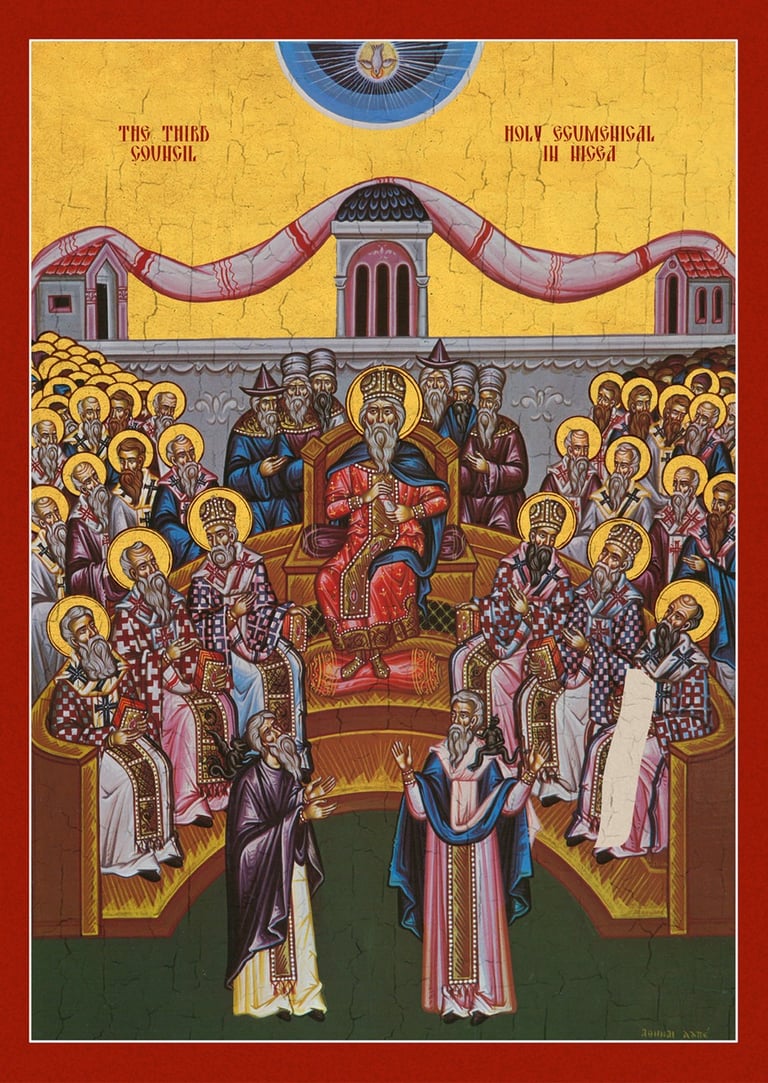
The First Council of Nicaea (325) addressed the status of deaconesses among the Paulianists, a heretical sect, decreeing: “With regard to the deaconesses who hold this position, we remind that they possess no ordination, but are to be reckoned among the laity in every respect” (Canon 19). This canon indicates that even the female diaconate among heretics was not considered equivalent to sacramental ordination.
The Council of Chalcedon (451) legislated regarding the minimum age for deaconesses: “A woman shall not receive the laying on of hands as a deaconess under forty years of age, and then only after searching examination” (Canon 15). The existence of female deacons in the ancient Church is well attested, but their ministry was distinct from that of ordained deacons, being directed primarily to the service of women, particularly in connection with baptism.
The Council of Trullo (692) reaffirmed the age requirements, stating: “Let no deacon be ordained before he is twenty-five, nor a deaconess before she is forty” (Canon 14). The fact that different age requirements obtained for male and female deacons suggests a distinction in the nature of the offices.
Local Synodal Legislation
Local synods in the Western Church explicitly prohibited the ordination of women to presbyteral functions:
The Synod of Laodicea (c. 363-364) decreed: “It is not allowed for those women who are called priests or those presiding to be ordained in the Churches” (Canon 11).
The Synod of Orange (441) legislated: “Altogether no women deacons are to be ordained. If some already exist, let them bend their heads to the blessing given to the lay people” (Canon 26).
The Synod of Epaon (517) determined: “We abrogate the consecration of widows whom they call deaconesses completely from our region” (Canon 21).
These local synods, whilst not having the authority of Ecumenical Councils, testify to the consistent understanding and practice of the Western Church.
The Position of the Ancient Apostolic Catholic Church
The Ancient Apostolic Catholic Church, standing within the apostolic succession and holding fast to the Catholic faith, affirms that the ordination of women to the diaconate, presbyterate, and episcopate is not within the competence of the Church. This is not a matter of policy that the Synod of Bishops may revise according to changing circumstances. It is a matter of divine institution that the Church must faithfully transmit.
We recognise that this position sets us apart from many of our sister jurisdictions in the Independent Catholic Movement. We do not judge those who have taken a different path, nor do we question their sincere convictions. We simply bear witness to our own understanding of what fidelity to the apostolic deposit requires.
We affirm the absolute dignity of women. We celebrate their indispensable contributions to the life and mission of the Church. We acknowledge that the Church has often failed to honour women as she ought and that structural reforms are needed to ensure their full participation in ecclesial governance, counsel, and ministry. However, we maintain that the ordained ministry is not the sole or even the primary arena for the exercise of gifts and charisms. The Church is not impoverished but enriched by the complementary vocations of men and women working together in mutual respect and holy collaboration.
In preserving this discipline, we stand with the Roman Catholic Church, the Eastern Orthodox Churches, and the Oriental Orthodox Churches. We stand with the Apostles who received this ministry from Christ, with the Fathers who transmitted it, with the Councils that legislated concerning it, with the Doctors who reflected upon it, and with the Saints who lived it. We believe that this witness, far from being a burden, is a gift to be cherished and a trust to be guarded until the Lord returns.
Doctors of the Church
St Thomas Aquinas
The Angelic Doctor provides the most systematic medieval treatment of this question in his Summa Theologica. Addressing whether the female sex constitutes an impediment to receiving Holy Orders, he writes:
“Certain things are required in the recipient of a sacrament as being requisite for the validity of the sacrament, and if such things be lacking, one can receive neither the sacrament nor the reality of the sacrament… Accordingly we must say that the male sex is required for receiving Orders not only in the second way [lawfulness], but also in the first way [validity]. Wherefore even though a woman were made the object of all that is done in conferring Orders, she would not receive Orders, for since a sacrament is a sign, not only the thing, but the signification of the thing, is required in all sacramental actions… Accordingly, since it is not possible in the female sex to signify eminence of degree, for a woman is in the state of subjection, it follows that she cannot receive the sacrament of Order” (Suppl. q. 39, a. 1).
Whilst modern readers may reject Thomas’s language about women being “in the state of subjection,” his fundamental argument about sacramental signification remains theologically cogent. The priest acts in persona Christi Capitis, in the person of Christ the Head, and this representation requires natural resemblance between the sign and the signified.
St Bonaventure
The Seraphic Doctor similarly addressed this question, arguing that “only the male person presents a true image of God” in the specific context of priestly representation (Commentary on the Sentences IV, dist. 25, a. 2, q. 1). Like Thomas, Bonaventure roots the impossibility of female ordination in the sacramental economy rather than mere disciplinary choice.
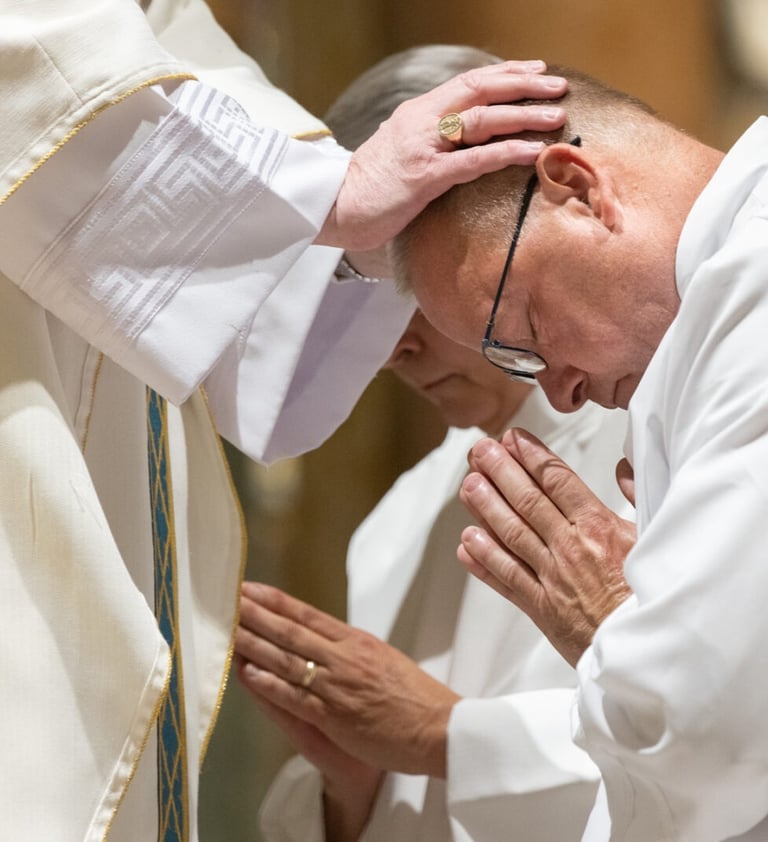
The Modern Magisterium
Inter Insigniores (1976)
The Sacred Congregation for the Doctrine of the Faith, under Pope Paul VI, issued a formal Declaration on the Question of Admission of Women to the Ministerial Priesthood. This document summarised the Church’s position under three principal arguments:
First, the example recorded in Sacred Scripture of Christ choosing his Apostles only from among men.
Second, the constant practice of the Church, which has imitated Christ in choosing only men for priestly ordination.
Third, the living teaching authority of the Church, which has consistently held that the exclusion of women from the priesthood is in accordance with God’s plan for his Church.
The Declaration further developed the theological argument from representation: “The priest… then acts in persona Christi, taking the role of Christ, to the point of being his very image, when he pronounces the words of consecration.” This sacramental symbolism, the document argues, requires that the minister bear a natural resemblance to Christ.
Ordinatio Sacerdotalis (1994)
Pope St John Paul II issued this Apostolic Letter to remove all doubt regarding the definitive nature of this teaching:
“Wherefore, in order that all doubt may be removed regarding a matter of great importance, a matter which pertains to the Church’s divine constitution itself, in virtue of my ministry of confirming the brethren (cf. Lk 22:32), I declare that the Church has no authority whatsoever to confer priestly ordination on women and that this judgment is to be definitively held by all the Church’s faithful.”
The key assertion is not merely that the Church chooses not to ordain women, but that the Church lacks the authority to do so. This teaching is presented as belonging to the divine constitution of the Church, not merely to ecclesiastical discipline.
The Responsum of 1995
The Congregation for the Doctrine of the Faith, with papal approval, subsequently clarified that the teaching of Ordinatio Sacerdotalis “requires definitive assent, since, founded on the written Word of God, and from the beginning constantly preserved and applied in the Tradition of the Church, it has been set forth infallibly by the ordinary and universal Magisterium.”
Dignitatem and the Dignity of Women
It is essential to affirm that the reservation of ordination to men does not imply the inferiority of women. Pope St John Paul II’s Apostolic Letter Mulieris Dignitatem (1988) provides a rich meditation on the dignity and vocation of women. The Pope notes that “the fact that the Blessed Virgin Mary, Mother of God and Mother of the Church, received neither the mission proper to the Apostles nor the ministerial priesthood clearly shows that the non-admission of women to priestly ordination cannot mean that women are of lesser dignity, nor can it be construed as discrimination against them.”
The Church affirms the absolute equality of men and women in dignity, grace, and eternal destiny. The distinction of roles in sacramental ministry does not imply a hierarchy of value but rather reflects the complementary character of male and female in God’s creative design.
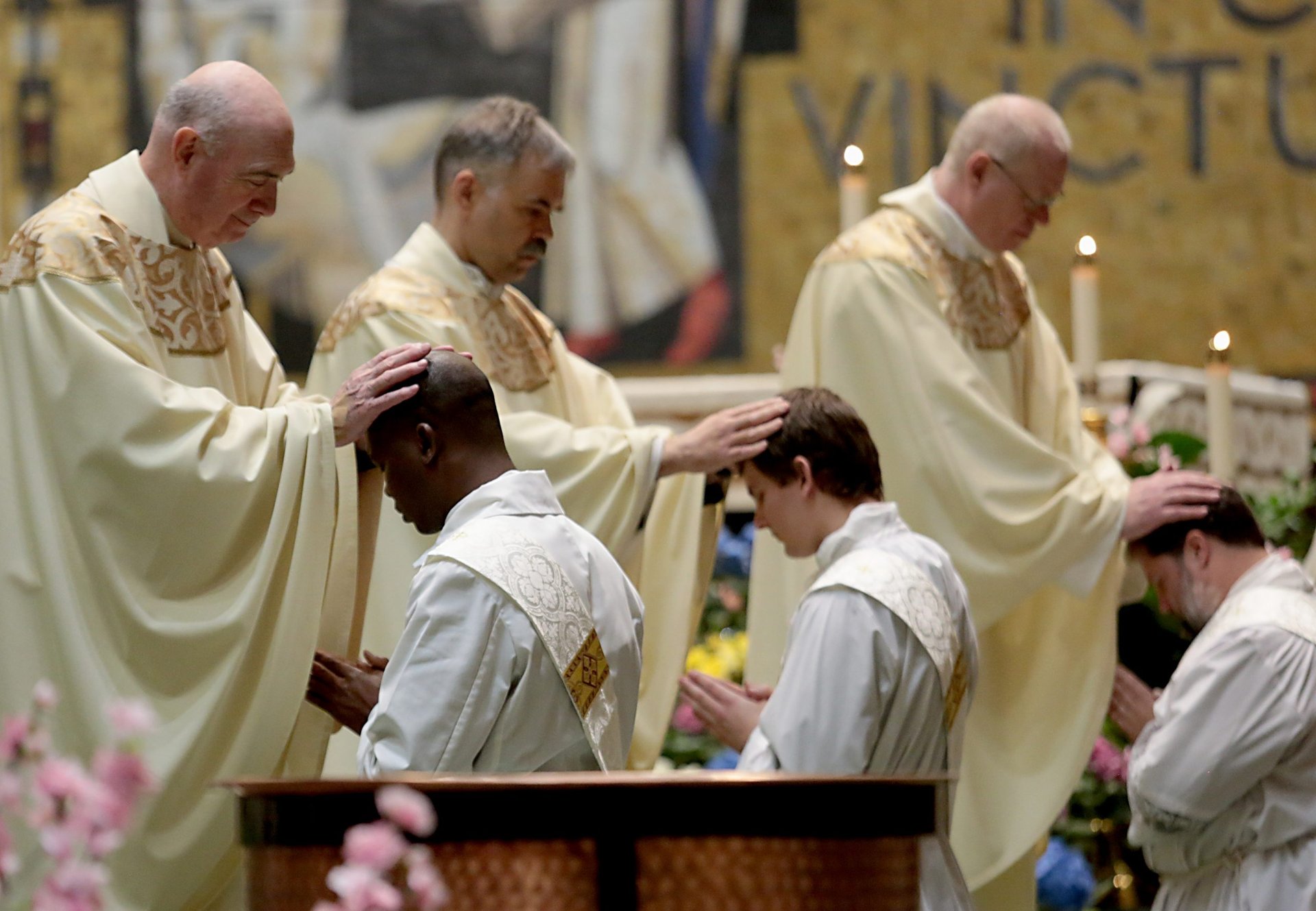
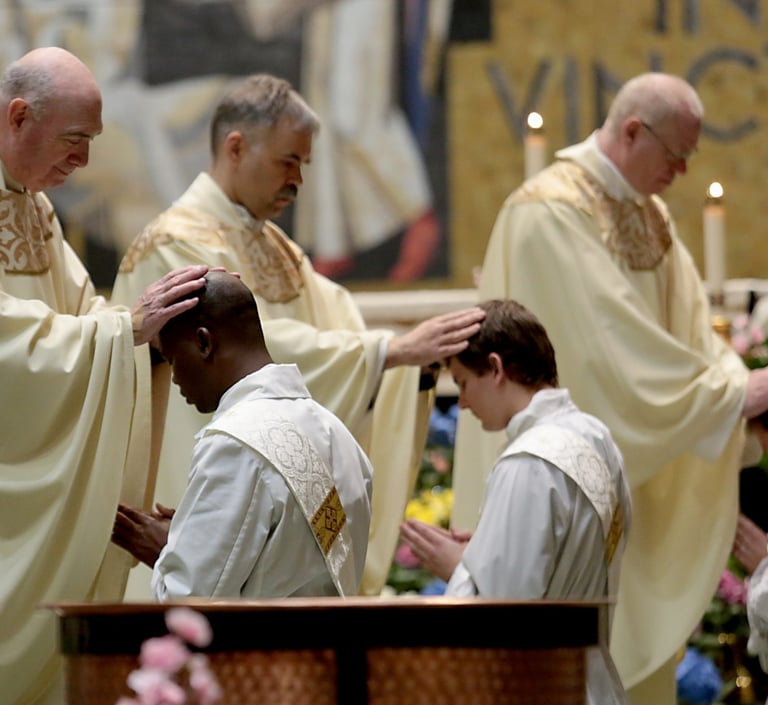
Theological Synthesis
The Nuptial Mystery
The deepest theological understanding of the male priesthood is found in the nuptial symbolism that pervades Scripture. From the prophets of Israel to the Book of Revelation, God’s relationship with his people is portrayed in spousal terms. Christ is the Bridegroom; the Church is his Bride.
At the Eucharist, this nuptial mystery is made present. The priest, acting in persona Christi, represents the Bridegroom who gives himself totally to his Bride. As St Paul teaches, “Husbands, love your wives, as Christ loved the church and gave himself up for her” (Eph 5:25). The priest’s role is essentially spousal: he stands in the place of the Bridegroom before the Bride.
This symbolism requires that the priest be male. Just as the Church, comprising both men and women, can be symbolically represented as the Bride, so Christ the Bridegroom must be represented by a man. To alter this arrangement would be to rupture the sacramental sign and sever it from its theological meaning.
Apostolic Succession and the Deposit of Faith
The Church does not have unlimited authority to alter what she has received from Christ. The ministerial priesthood is not a human institution that the Church may reshape according to pastoral convenience or cultural pressure. It is a gift received from the Lord, to be faithfully transmitted to future generations.
The bishops, as successors of the Apostles, are stewards of this deposit. Their task is not to innovate but to preserve. When the Church declares that she lacks authority to ordain women, she is acknowledging the limits of her own competence. She can develop doctrine; she cannot contradict it. She can adapt discipline; she cannot overturn divine institution.
The Witness of the Orthodox Churches
The Roman Catholic Church is not alone in maintaining this discipline. The Eastern Orthodox Churches, whilst not in communion with Rome, share this understanding. The Ecumenical Patriarch, the Patriarch of Moscow, and the other autocephalous Churches all reserve ordination to men. This convergence of East and West, despite centuries of separation, constitutes powerful testimony to the apostolic character of this teaching.
Sources and References
Sacred Scripture - Genesis 1:27; 2:18-25; 3:16 - Matthew 10:1-5; 16:18; 19:28; 28:1-10 - Mark 3:13-19; 6:30 - Luke 6:12-16; 8:1-3; 10:1-16; 22:32 - John 4:27; 6:64, 70-71; 8:3-11; 20:11-18 - Acts 1:2, 13, 20-26; 6:1-6 - Romans 16:1-7 - 1 Corinthians 11:1-16; 14:33-38 - Galatians 1:19; 3:28 - Ephesians 2:20; 5:21-33 - Philippians 4:2-3 - 1 Timothy 2:11-15; 3:1-13 - Titus 1:5-9 - Revelation 21:14
Church Fathers - St Irenaeus of Lyon, Against Heresies - Tertullian, On the Veiling of Virgins; On the Prescription Against Heretics - Origen, Fragments on 1 Corinthians - St Epiphanius of Salamis, Panarion - St John Chrysostom, On the Priesthood - St Augustine of Hippo, On Heresies
Ecumenical Councils - First Council of Nicaea (325), Canon 19 - Council of Chalcedon (451), Canon 15 - Council of Trullo (692), Canon 14 - Second Council of Nicaea (787), Canon 1
Local Synods - Synod of Laodicea (c. 363-364), Canon 11 - Synod of Orange (441), Canon 26 - Synod of Epaon (517), Canon 21
Doctors of the Church - St Thomas Aquinas, Summa Theologica, Supplement, q. 39 - St Bonaventure, Commentary on the Sentences, IV, dist. 25
Magisterial Documents - Paul VI, Letter to the Archbishop of Canterbury (30 November 1975) - Congregation for the Doctrine of the Faith, Inter Insigniores (15 October 1976) - John Paul II, Mulieris Dignitatem (15 August 1988) - John Paul II, Ordinatio Sacerdotalis (22 May 1994) - Congregation for the Doctrine of the Faith, Responsum ad Dubium (28 October 1995) - Catechism of the Catholic Church, §1577
Subscribe Today
The Pilgrim Chronicle's is published as a quarterly newsletter full of articles, news and personal reflections. Complete the form below to be included in our subscriber's emails.
About the Ancient Apostolic Catholic Church
Fostering faith, inclusion, and compassionate service within a vibrant community and beyond.
Who Are We?
The Ancient Apostolic Catholic Church is a community that proudly carries forward the rich heritage of the Roman Catholic tradition while embracing a spirit of inclusivity and family.
Governance
The Ancient Apostolic Catholic Church operates under a structured and inclusive governance model that reflects its commitment to apostolic tradition, pastoral care, and community engagement.
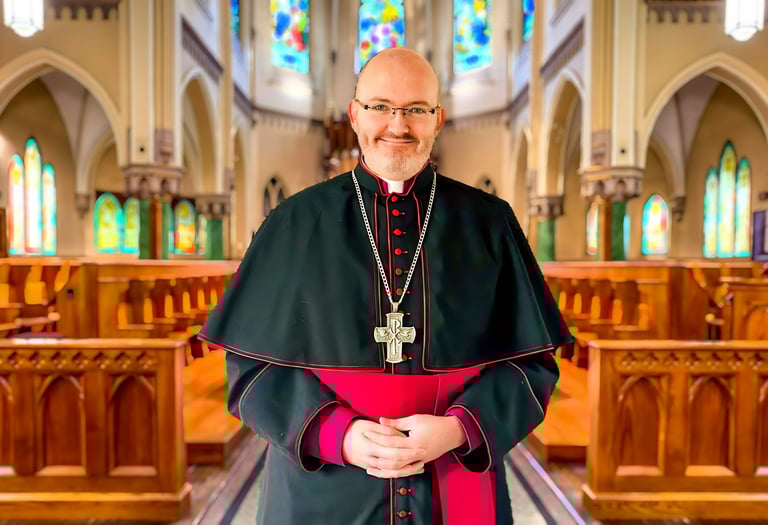
Archbishop Felix Gibbins is the spiritual leader and Primate of the Ancient Apostolic Catholic and Metropolitan of the historical Archdiocese of the Holy Primatial See of the East Angles.
Meet Archbishop Felix


Safeguarding Policy
Data Protection Policy
Spiritual Formation Policy
Our safeguarding policy reflects the Church’s mission to be a safe haven for all, especially children, young people, and vulnerable adults.
Dedicated to protecting the privacy and personal data of its clergy, seminarians, staff, parishioners, and associated parties in accordance with (UK GDPR).
The policy is intended to nurture a deep, authentic relationship with God and to prepare candidates for a lifetime of service steeped in the wisdom of the Church Fathers/

Ancient Apostolic Catholic Church
Embracing faith, inclusion, and compassionate service together.
ST THOMAS AQUINAS SEMINARY
© 2026. All rights reserved
QUICK LINKS
ORDER OF ST DAVID