Feast of St Thomas Becket
On this feast, we are not invited to admire Thomas from a safe distance. We are invited to let his courage interrogate our complacency. To let his fidelity strengthen our resolve. To let his martyrdom disturb us into holiness.
SAINTS
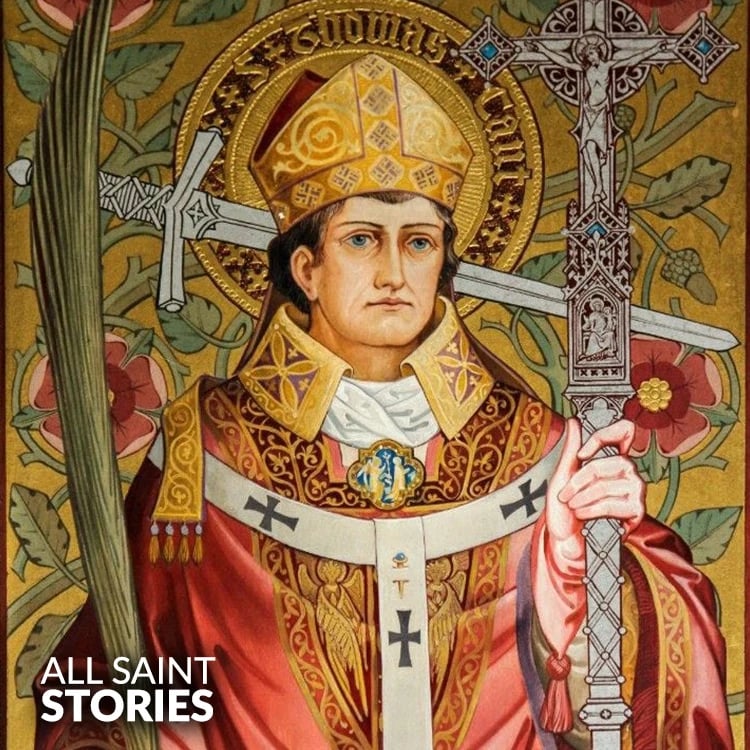
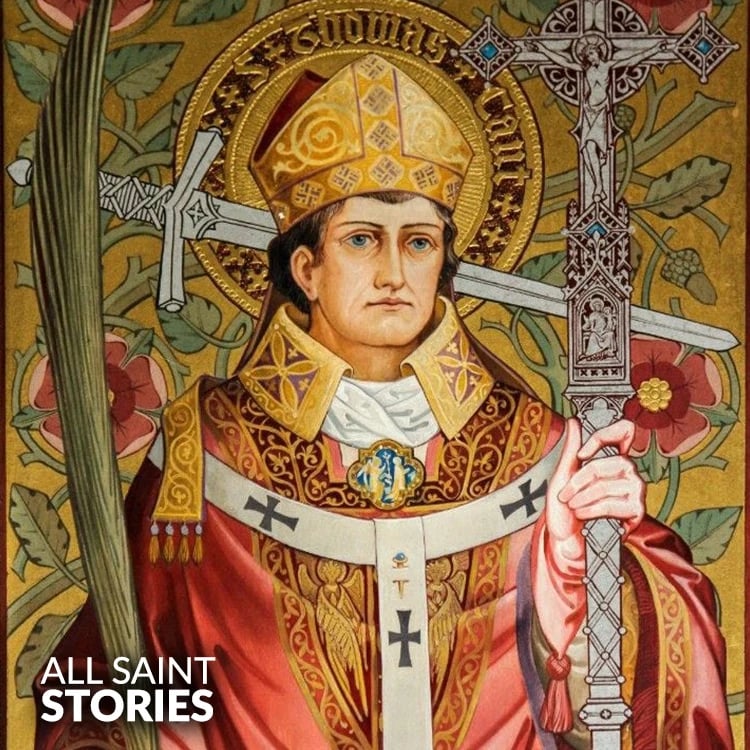
Homily for the Feast of St Thomas Becket Given by Archbishop Felix Gibbins OSB Cam, 29th Dec 2025
My friends, today the Church gives us the Feast of St Thomas Becket, a feast that refuses to let us settle for a comfortable, easy Christianity. Martyrs never let us do that. They interrupt us. They stand in our path like a living Gospel, asking not simply to be admired, but to be imitated. And Thomas Becket, in particular, confronts us with the sharp edge of discipleship: the cost of fidelity, the courage of conscience, and the unshakeable primacy of Christ.
Thomas Becket did not begin his life as a firebrand or a rebel. He was a man of influence, a close friend of King Henry II, someone deeply woven into the political life of England. When he was appointed Archbishop of Canterbury, many assumed he would be a convenient ally to the Crown. But grace has a way of surprising us.
Something in Thomas changed. His heart awakened to the deeper demands of the Gospel. His loyalties shifted. His conscience sharpened. And suddenly, the man who once served the king became the man who stood against him, not out of pride, not out of stubbornness, but out of obedience to a higher authority.
Martyrdom, you see, is never about seeking death. It is about refusing to abandon truth. Thomas did not desire conflict. But he refused to let the Church become a tool of the state. He refused to let the Gospel be trimmed to fit the preferences of the powerful. He refused to let fear dictate his fidelity. His defiance was not rebellion for its own sake; it was the obedience of a disciple who had discovered that Christ’s claim on his life was absolute.
And that is why his witness still unsettles us today. Thomas Becket holds up a mirror. He forces us to confront the places where we have made peace with convenience instead of conscience. He exposes the subtle compromises we accept simply because they keep us safe, respected, or undisturbed. He challenges the ways we sometimes prefer a faith that is admired rather than a faith that is faithful.
Martyrdom, whether the red martyrdom of blood or the white martyrdom of daily sacrifice, begins long before the moment of death. It begins in the quiet, hidden decisions to let Christ’s voice be the loudest in our lives. It begins in the willingness to disappoint the world in order to be true to the Kingdom.
Now, we may not face swords in a cathedral. But we face pressures of a different kind: the pressure to privatise our faith, to soften the Gospel so it offends no one, to remain silent when truth becomes costly. The world still rewards compliance and punishes conviction. And yet, Thomas Becket shows us that holiness is not passive. It is courageous. It is discerning. It is costly. It demands that we resist the temptation to be agreeable when Christ calls us to be faithful.
But remember this: the martyr never points to himself. Thomas Becket’s blood does not glorify Thomas Becket. It glorifies Christ, the Christ who stood before Pilate with unflinching truth, the Christ who embraced the Cross rather than betray the Father’s will, the Christ who teaches us that losing our life for His sake is the only way to truly find it.
Thomas’s witness is not a relic of a heroic past. It is a summons for us today, a summons to courage, to integrity, to a love for Christ that is stronger than fear.
So, on this feast, we are not invited to admire Thomas from a safe distance. We are invited to let his courage interrogate our complacency. To let his fidelity strengthen our resolve. To let his martyrdom disturb us into holiness.
May St Thomas Becket pray for us, that we too may choose Christ above all earthly powers, and that our lives – whether in quiet witness or bold defiance – may lead others to Him.
Questions for Reflection
Where in my life have I chosen convenience over conscience
What fears keep me from speaking or living the Gospel more boldly
Whose approval do I value more than God’s, and why
What would “white martyrdom” look like in my daily choices
How is Christ inviting me to deeper courage and fidelity today
Ancient Apostolic Catholic Church
Embracing faith, inclusion, and compassionate service together.
ST THOMAS AQUINAS SEMINARY
© 2026. All rights reserved
QUICK LINKS
Prayer Requests
Mass Intentions
Requiem Mass
Contact Us
Pilgrim Chronicles
ORDER OF ST DAVID
ORDER OF THE KNIGHTS OF ST MARY OF BETHLEHEM