Guardians of the Sacred Tradition
We cannot support policies that treat the sacred liturgy as administrative territory to be managed rather than divine gift to be guarded. St Benedict, whose Rule guides our Camaldolese community, taught that nothing should be preferred to the Work of God, the liturgy.
BLESSED SACRAMENTDOCTRINELITURGY
The Independent Catholic Witness in a Time of Liturgical Crisis
A Time of Both Hope and Concern
The opening weeks of 2026 have brought two significant developments in the life of the universal Church that merit serious reflection. On 9 January, Pope Leo XIV delivered his inaugural address to the diplomatic corps, offering a prophetic and deeply welcome critique of the ideological distortions afflicting contemporary society. Yet just days earlier, a leaked document from Cardinal Arthur Roche, distributed during the extraordinary consistory of cardinals, revealed the continuing pressure to suppress the Traditional Latin Mass, framing it not as a treasured inheritance of Catholic Christendom, but as a mere concession destined for extinction.
For independent Catholic jurisdictions such as the Ancient Apostolic Catholic Church, these simultaneous developments present both an occasion for solidarity with the Holy Father’s teaching on social justice and a solemn duty to stand in defence of the sacred liturgy that Rome appears increasingly willing to abandon.
Pope Leo’s Prophetic Voice Against Ideology
The Holy Father’s address to the diplomatic corps stands as a powerful witness to Catholic social teaching. In words that echo the patristic boldness of his patron saint Leo the Great, he warned against the rise of what he termed “Orwellian-style language” that, “in an attempt to be increasingly inclusive, ends up excluding those who do not conform to the ideologies that are fuelling it.”
This courageous proclamation deserves the full support of Catholic faithful everywhere. Pope Leo rightly identified how Christians “are sometimes restricted in their ability to proclaim the truths of the Gospel for political or ideological reasons, especially when they defend the dignity of the weakest, the unborn, refugees and migrants, or promote the family.” Such defence of the vulnerable is not merely political commentary; it is the consistent teaching of the Church through all ages.
The Ancient Apostolic Catholic Church stands unreservedly with Pope Leo XIV in this prophetic witness. The Corporal Works of Mercy, feeding the hungry, sheltering the homeless, welcoming the stranger, are not optional extras of the Christian life but flow directly from the Eucharistic sacrifice itself. As Pope Leo has written elsewhere, “The Church, like a mother, accompanies those who are walking. Where the world sees threats, she sees children; where walls are built, she builds bridges.”
It is precisely because we share this commitment to the defence of human dignity that we must also speak when we believe the Church is in error, and the treatment of the Traditional Latin Mass represents such an error of profound consequence.
The Roche Document: A Troubling Vision
The document prepared by Cardinal Arthur Roche, Prefect of the Dicastery for Divine Worship, and distributed to cardinals during the January consistory, represents a stark vision for the future of the Roman liturgy. Though the liturgy was ultimately not formally discussed, having been voted aside by the cardinals in favour of other topics, the text reveals the direction in which Vatican policy continues to move.
Cardinal Roche’s document asserts that the Missal of Paul VI constitutes “the sole expression of the lex orandi of the Roman Rite.” The use of the 1962 Missal, he argues, was “a concession that in no way envisaged their promotion.” The document frames attachment to the older liturgy as fundamentally “ecclesiological”, that is, as a proxy for rejecting the Second Vatican Council itself.
This framing is both historically inaccurate and pastorally destructive. The Traditional Latin Mass is not a deviation from Catholic faith; it is the Mass that formed countless saints, educated generations of theologians, and expressed the Catholic faith for centuries. To treat it as a wound to be “cauterised,” in the words of one commentator, is to treat our spiritual ancestors as problems to be solved rather than witnesses to be honoured.
Lex Orandi, Lex Credendi: An Ancient Principle at Stake
The phrase lex orandi, lex credendi, the law of prayer is the law of belief, comes to us from St Prosper of Aquitaine in the fifth century. In its original formulation, legem credendi lex statuat supplicandi, it expresses the profound truth that how we worship shapes what we believe. The liturgy is not merely a cultural container for timeless doctrines; it is the living heart of Catholic faith, the place where heaven meets earth.
This principle explains why the question of the Traditional Mass is far more than a matter of aesthetic preference. When the liturgy changes, belief inevitably follows. The Traditional Latin Mass, with its emphasis on the sacrificial nature of the Eucharist, the ministerial priesthood, the sacred and transcendent character of worship, and the continuity of Catholic tradition, teaches the faith in ways that go beyond words.
St John Henry Newman understood this well when he wrote that the Mass is “the most august action that can possibly be performed.” The Traditional Rite communicates this augustness through every gesture, every silence, every chant. To suppress it is not to preserve unity but to impoverish the Church’s treasury of sacred worship.
The Scriptural and Patristic Witness
The prophet Malachi speaks words that the Church has always understood as prophetic of the Holy Sacrifice of the Mass: “For from the rising of the sun to its setting my name is great among the nations, and in every place incense is offered to my name, and a pure offering” (Malachi 1:11). From the earliest centuries, the Church Fathers recognised in this text a description of the Eucharistic sacrifice that would be offered throughout the world.
The Didache, one of our oldest Christian texts, directly echoes Malachi when instructing the faithful: “On the Lord’s day, after you have come together, break bread and offer Eucharist, having first confessed your offences, so that your sacrifice may be pure.” This “pure sacrifice” is what the Traditional Mass visibly and unmistakably presents: the unbloody re-presentation of Calvary, offered for the living and the dead.
St Pius V, in promulgating the Missal of 1570, sought precisely to preserve this sacrificial character and to ensure liturgical stability. His apostolic constitution Quo Primum granted that the Missal “may be followed absolutely, without any scruple of conscience or fear of incurring any penalty, judgment, or censure, and may freely and lawfully be used” in perpetuity. While canonists may debate the technical force of such language, the underlying intention is clear: the Traditional Mass is not an experiment to be revised at will but a patrimony to be guarded.
The Witness of Independent Catholic Churches
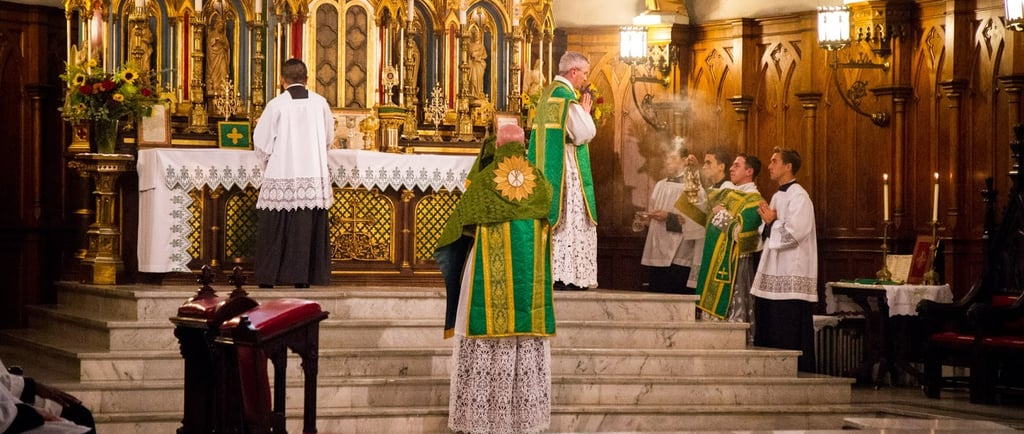
In an era when the Roman See increasingly treats the Traditional Latin Mass as a problem to be managed rather than a treasure to be cherished, independent Catholic jurisdictions such as the Ancient Apostolic Catholic Church find ourselves called to a particular mission. We do not seek to replace Rome or to deny her historic significance; rather, we seek to preserve what Rome now appears willing to abandon.
The AACC maintains the traditional Latin liturgy not from nostalgic attachment but from theological conviction. We believe, with the Church of all ages, that the Holy Sacrifice of the Mass is “the source and summit of the Christian life” (Lumen Gentium 11), and that the Traditional Rite expresses this reality with a fullness and clarity that must not be lost.
We stand ready to serve communities worldwide who seek the Traditional Mass. Where bishops have restricted or abolished the older liturgy, we offer a canonical home. Where the faithful have been told that their love of tradition is a form of disloyalty, we remind them that fidelity to Christ cannot be measured by conformity to administrative decrees.
As St Athanasius once said during an earlier crisis of the Church, “They have the buildings, but we have the faith.” In our own day, we might adapt these words: they may control the structures, but we preserve the liturgy.
The Question of Unity
Cardinal Roche’s document appeals repeatedly to “unity” as justification for suppressing liturgical diversity within the Latin Rite. Yet this appeal is undermined by two stubborn realities.
First, the Catholic Church has never been liturgically monolithic. The Eastern Churches in communion with Rome maintain their own ancient rites. Within the Western Church, the Ambrosian, Mozarabic, and Dominican rites have long coexisted with the Roman. More recently, the Anglican Ordinariate has been granted its own distinctive liturgical books. If such diversity is compatible with Catholic unity, why must the Traditional Latin Mass be treated as uniquely divisive?
Second, the communities devoted to the Traditional Mass have consistently affirmed their loyalty to the Second Vatican Council. What they contest is not the Council’s authority but the claim that the Council mandated the specific reforms that followed. As the constitution Sacrosanctum Concilium itself stated, “the use of the Latin language is to be preserved in the Latin rites” (SC 36) and “there must be no innovations unless the good of the Church genuinely and certainly requires them” (SC 23).
True unity is found not in uniformity of rite but in common faith, common sacraments, and common charity. The AACC seeks this unity while maintaining that the preservation of the Traditional Mass serves rather than hinders the Church’s mission.
The Sacramental Ministry of the AACC
The Ancient Apostolic Catholic Church exercises a sacramental ministry rooted in valid apostolic succession and faithful to the doctrinal and liturgical patrimony of the Catholic Church. Our bishops and priests offer the Traditional Latin Mass, administer the sacraments according to the older rituals, and seek to form the faithful in the fullness of Catholic doctrine.
We welcome all who seek the Traditional Mass, whether lifelong devotees of the older liturgy, refugees from dioceses that have suppressed it, or newcomers drawn by the beauty of sacred worship. Our parishes and missions provide a stable home for traditional Catholic practice, free from the uncertainty that currently afflicts communities dependent on Roman episcopal permission.
We do not claim perfection; we are pilgrims like all Christians. But we do claim fidelity, fidelity to the Mass of the ages, fidelity to the faith once delivered to the saints, fidelity to the countless generations who worshipped God in this sacred rite and who now pray for us from the heavenly liturgy.
A Call to Hope
The present moment is one of both crisis and opportunity. The crisis is real: the Traditional Latin Mass faces continuing restriction and potential suppression within Roman jurisdiction. Yet the opportunity is equally real: independent Catholic jurisdictions can and must serve as bastions of liturgical tradition, preserving what threatens to be lost.
We support Pope Leo XIV in his prophetic witness against ideological distortion and his defence of the vulnerable. We pray for his pontificate and for the unity of all Christians. But we cannot support policies that treat the sacred liturgy as administrative territory to be managed rather than divine gift to be guarded.
St Benedict, whose Rule guides our Camaldolese community, taught that nothing should be preferred to the Work of God, the liturgy. In that spirit, we commit ourselves to the preservation and promotion of the Traditional Latin Mass, confident that the God who gave us this sacred worship will not abandon those who cherish it.
The prophet Jeremiah offers words of encouragement for our time: “Stand at the crossroads and look; ask for the ancient paths, ask where the good way is, and walk in it, and you will find rest for your souls” (Jeremiah 6:16). May all who seek those ancient paths find in the Traditional Mass a road that leads to Christ.
†
Pax et Bonum
✠ ✠ ✠ Felix Gibbins OSB Cam
Primate and Presiding Archbishop
Ancient Apostolic Catholic Church
January 2026
Ancient Apostolic Catholic Church
Embracing faith, inclusion, and compassionate service together.
ST THOMAS AQUINAS SEMINARY
© 2026. All rights reserved
QUICK LINKS
Prayer Requests
Mass Intentions
Requiem Mass
Contact Us
Pilgrim Chronicles
ORDER OF ST DAVID
ORDER OF THE KNIGHTS OF ST MARY OF BETHLEHEM