Homily: Saint Anselm of Canterbury
We are, all of us, swimming in competing narratives. On any given day, we are presented with multiple versions of events, multiple interpretations, multiple people telling us that the other side is not just wrong but dangerous.
HOMILIES
Feast Day: 21st April
How many of you checked your phone this morning before you got out of bed? And before we had even had a cup of tea, we had already been told what to think about at least three things we had not been thinking about the night before. Then someone disagreed with someone else about one of those things, and someone else shared something that turned out not to be true, and by the time we arrived here we were carrying a low-level hum of noise that is just… the texture of daily life now.
It is exhausting. And I think, if we are honest, it is making it harder to think clearly.
That is why I want to talk about Anselm today.
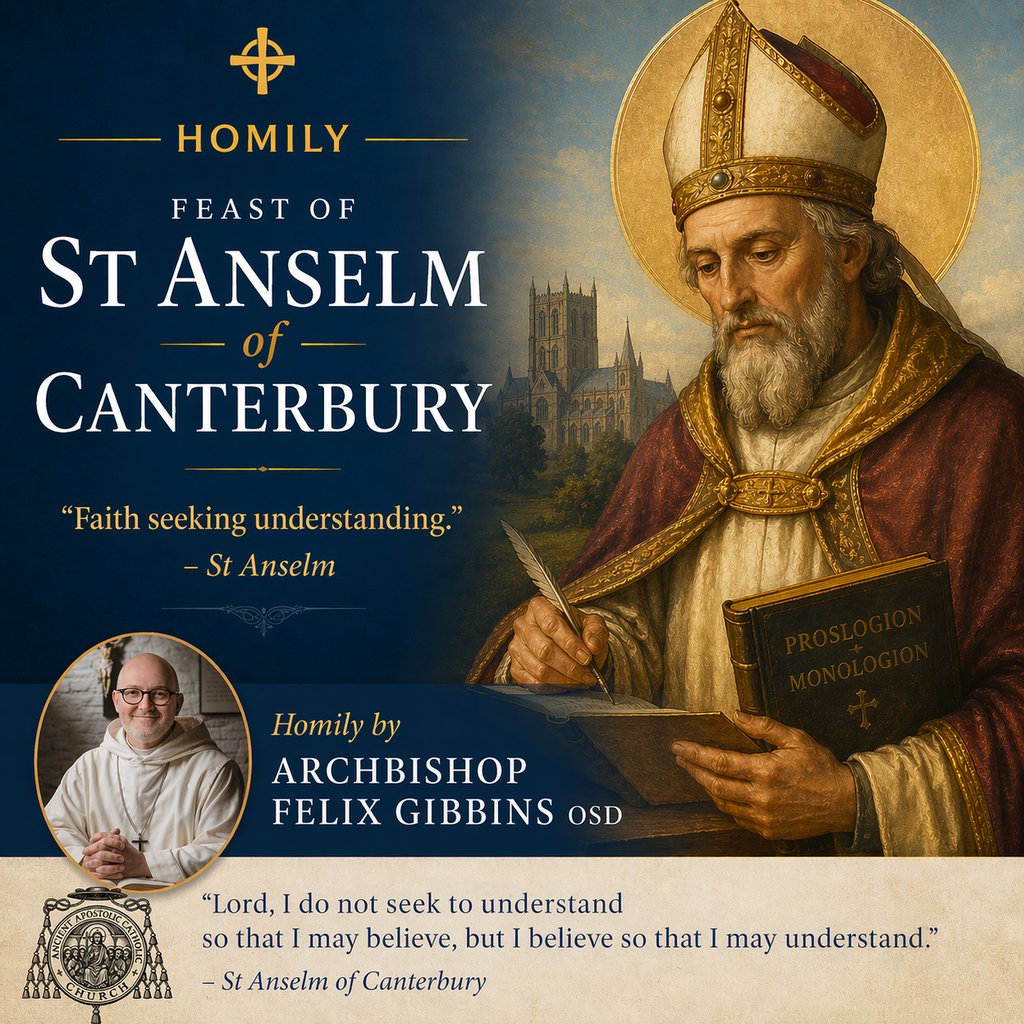
He was born in 1033, became a monk at the monastery of Bec in Normandy, and eventually – reluctantly, if the accounts are to be believed – became Archbishop of Canterbury. He was a remarkable theologian, one of the most significant the Church has ever produced. But what I want to focus on today is not his conclusions. It is his method. Because his method is precisely what we seem to have lost.
Anselm described his whole approach to faith and thinking with a phrase that became his hallmark: fides quaerens intellectum. Faith seeking understanding. Not faith instead of understanding. Not understanding instead of faith. The two together, each serving the other. He put it this way in his Proslogion: “I do not seek to understand in order to believe; but I believe in order to understand.”
Now, read that slowly, because it cuts against two things we tend to do.
The first is the idea that faith is something you hold onto by not asking questions. That doubt is dangerous, that inquiry is somehow disloyal to God. Anselm would have had no patience with that. He spent his entire life asking questions. Hard ones. He wrote a book asking why God became man. He constructed one of the most debated arguments in the history of philosophy for the existence of God. He was not afraid of the question. He trusted that honest inquiry, conducted in a spirit of faith, would lead somewhere true.
The second thing it cuts against is the assumption – very common in our culture right now – that reason and faith are simply incompatible. That once you believe something, you have stopped thinking. Anselm shows that this is exactly backwards. For him, faith is not the end of inquiry. It is the ground from which inquiry begins. You start by trusting God, and from within that trust you reach further and further into understanding. The two are not enemies.
That is a genuinely countercultural idea in 2025. We live in a world that tends to push people towards one of two camps: either you believe things without evidence and call it faith, or you reason things out without reference to God and call it intelligence. Anselm simply refused that choice. He refused it not because he was trying to be clever, but because it was not true to his experience of God or his experience of thought.
And here is where I think his witness matters most right now.
We are, all of us, swimming in competing narratives. On any given day, we are presented with multiple versions of events, multiple interpretations, multiple people telling us that the other side is not just wrong but dangerous. Social media rewards the sharpest reaction, not the most careful thought. The loudest voice gets the most attention. And gradually – this is the real danger – we stop actually pursuing truth and start pursuing confirmation. We look for things that agree with us rather than things that are true.
The Book of Proverbs says: “If you call out for insight and raise your voice for understanding, if you seek it like silver and search for it as for hidden treasures, then you will understand the fear of the Lord and find the knowledge of God” (Proverbs 2:3-5). That image of searching, of effort, of genuine seeking – that is what Anselm modelled. Truth is not handed to us fully formed. It is found. It requires patience and humility and the willingness to be wrong.
Intellectual humility is genuinely rare right now, and that is worth naming. It is rare partly because being uncertain has become socially costly. If you say “I’m not sure” or “I might be wrong about this,” you are sometimes treated as weak or uncommitted. But Anselm, a man of enormous intellectual gifts and deep conviction, built his whole method on the acknowledgement that he was a finite creature approaching an infinite God. Of course there would be things he did not fully grasp. That was not a crisis of faith. It was honesty.
Saint Paul writes to the Colossians that in Christ “are hidden all the treasures of wisdom and knowledge” (Colossians 2:3). Hidden. Not displayed on a banner. Not downloadable in thirty seconds. Hidden, and worth searching for.
So what does this mean practically, for us, as a community?
It means that we should be a place where questions are actually welcome. Not managed, not deflected, not treated as threats – welcome. Someone asking a hard question about God is not someone who has stopped believing. Often they are someone who is taking belief seriously enough to push on it. That deserves a response, not a nervous change of subject.
It means we should be honest when we do not know something. The Church has a vast treasury of thought and teaching, and there is enormous confidence available to us from that inheritance. But there are also questions we are still wrestling with, things that are genuinely difficult, and pretending otherwise does not serve anyone.
And it means we should take seriously the discipline of formation – prayer, Scripture, the teaching of the Church, honest reflection on experience. These are not optional extras for the especially devout. They are how a conscience gets formed, how wisdom grows, how we become people capable of genuine discernment rather than just reaction.
Anselm died on the 21st of April 1109, still at work on a theological question he had not finished answering. He had asked to live long enough to complete it. He did not quite manage it. There is something very human in that – a man still reaching, still seeking understanding, right to the end. Not because he lacked faith. But because faith, for him, was always an opening towards more.
That is the kind of community the Church is called to be. Not one with all the answers pinned down and the questions safely behind glass. But one where faith and understanding grow together, honestly and patiently, and where the noise of the world quietens enough for us to actually hear what God might be saying.
Saint Anselm of Canterbury, pray for us.
In the name of the Father, and of the Son, and of the Holy Spirit.
+++Felix Gibbins OSD
Archbishop Primate
Ancient Apostolic Catholic Church
Embracing faith, inclusion, and compassionate service together.
ST THOMAS AQUINAS SEMINARY
© 2026. All rights reserved
QUICK LINKS
Prayer Requests
Mass Intentions
Requiem Mass
Contact Us
Pilgrim Chronicles
ORDER OF ST DAVID
ORDER OF THE KNIGHTS OF ST MARY OF BETHLEHEM