Independent Catholicism Explained
Independent Catholicism is Catholic because it holds and practises the historic faith of the apostles. That means the ancient Creeds, the seven sacraments, bishops ordained in apostolic succession, the veneration of saints, and a liturgical life inherited from the early Church.
CHURCH HISTORY
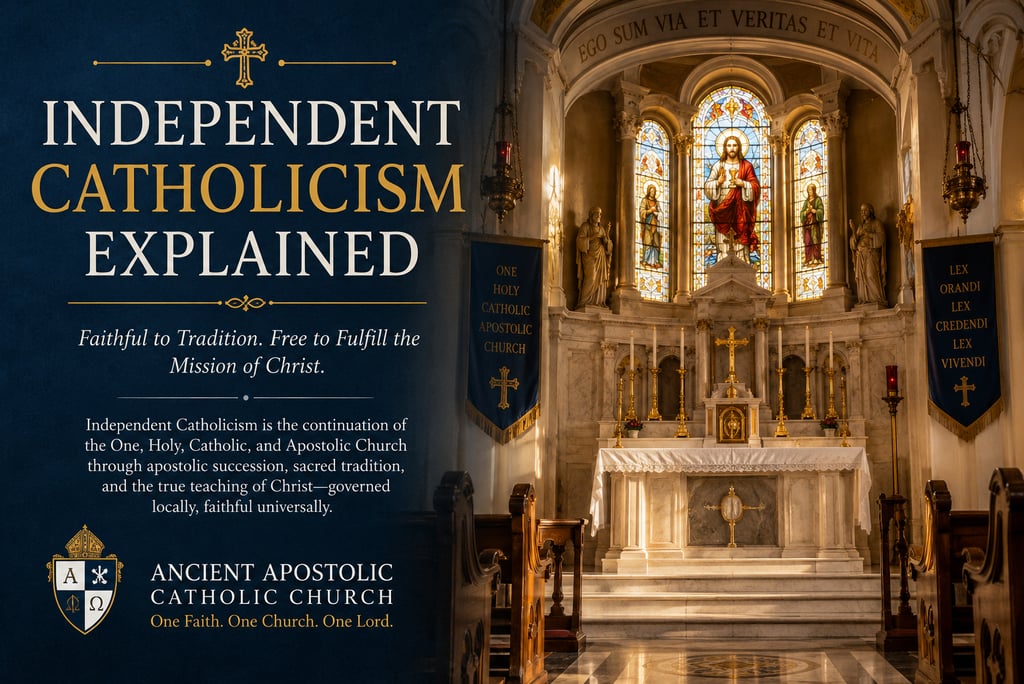
Independent Catholicism Explained
A guide for enquirers and those discerning a call to ministry
What does “Independent Catholic” actually mean?
Before anything else, it helps to answer this plainly.
Independent Catholicism is Catholic because it holds and practises the historic faith of the apostles. That means the ancient Creeds, the seven sacraments, bishops ordained in apostolic succession, the veneration of saints, and a liturgical life inherited from the early Church.
It is independent because it operates outside the jurisdiction of the Bishop of Rome. This is not the same as being cut off from the Catholic tradition. Several ancient communions — among them the Oriental Orthodox churches and the Eastern Orthodox churches — have stood outside Roman jurisdiction for centuries while maintaining what they hold to be genuine apostolic continuity. Independent Catholic jurisdictions stand in a similar position.
The simplest summary:
Independent Catholicism holds Catholic faith and sacramental practice, ordered under bishops in apostolic succession, without being governed by the Roman papacy. The difference from Rome is one of jurisdiction and governance, not of creed or sacrament.
I Apostolic faith
The Creeds, the seven sacraments, and the teaching of the undivided Church as the inheritance of all Catholic Christians.
II Valid orders
Episcopal ordination in traceable lines of apostolic succession, conferring authentic ministry and sacramental life.
III Conciliar governance
Authority shared among bishops in synod, reflecting the collegial model of the early Church.
The apostolic succession
Why episcopal lineage matters, and what it means for sacramental life.
The doctrine of apostolic succession holds that the authority entrusted by Christ to the apostles was transmitted from bishop to bishop through the laying-on of hands. This unbroken chain is not merely a historical curiosity. In Catholic theology, it is the basis on which the validity of ordinations and the authenticity of ordained ministry are understood to rest.
Independent Catholic churches do not simply adopt the name “Catholic” and act accordingly. Their claim depends on the integrity of their episcopal lineages. The most historically significant of these traces to the Old Catholic movement, and in particular to the Church of Utrecht in the Netherlands.
The Church of Utrecht separated from Rome in 1724, following a prolonged dispute over jurisdiction. It maintained a continuous episcopate which many theological observers regard as standing in valid apostolic succession — though, as with all questions of this kind, assessments differ across traditions. In the nineteenth century, the Utrecht bishops provided consecrations for the Old Catholic churches that formed after the First Vatican Council, and it is through those consecrations that many independent Catholic lineages descend.
Other lineages derive from the Brazilian Catholic Apostolic Church, from Eastern Catholic and Eastern Orthodox sources, and from the Catholicate of the West. Many independent Catholic bishops today hold multiple overlapping lines of succession, which strengthens rather than complicates the claim to apostolic continuity.
“The episcopate is one and undivided; each bishop has a share in the whole and each holds the whole.”
— Saint Cyprian of Carthage, On the Unity of the Church, c. 251 AD
A history longer than many assume
The roots of Catholic diversity predate the Reformation by many centuries.
Independent Catholicism is sometimes assumed to be a modern phenomenon — a product of recent dissatisfaction with Rome. The historical picture is more complex and considerably older.
Catholic Christianity has never existed in a single, undivided institutional form. The Council of Chalcedon in 451 AD produced a significant rupture: the Oriental Orthodox churches — Coptic, Armenian, Ethiopian, and Syriac — parted ways with the Chalcedonian settlement and developed their own episcopal and sacramental lives entirely independently of Rome. The Great Schism of 1054 divided Eastern and Western Christianity, producing the Orthodox churches of the East, which likewise maintained what they hold to be valid apostolic succession without Roman oversight.
The Old Catholic movement of the nineteenth century drew on this longer precedent. When the First Vatican Council defined papal infallibility in 1870, a number of German, Swiss, Dutch, and Austrian Catholics — including several bishops and considerable numbers of clergy — found themselves unable in conscience to accept the new definition. They did not leave the sacramental life of the Church. They reorganised under bishops already in valid succession, continued the ancient liturgy, and formed churches that have endured to the present day. In 1931 the Union of Utrecht entered into full communion with the Anglican Communion through the Bonn Agreement.
Modern independent Catholic jurisdictions, including the Ancient Apostolic Catholic Church, are heirs of this longer story.
What independent Catholics believe
Catholic faith and sacramental practice; a different understanding of church authority.
Independent Catholicism is sometimes confused with Protestantism. The two traditions have distinct origins and different theological commitments, and the distinction is worth making clearly.
Most Protestant traditions emerged from a reform movement that, in various ways, challenged the inherited structures of Western Christianity — including its hierarchical episcopate, the authority of tradition alongside scripture, and aspects of its sacramental theology. Those are substantial differences, and ecumenically serious Christians on all sides recognise them as such.
Independent Catholic churches, by contrast, trace their identity to the same episcopal, sacramental, and creedal inheritance as Rome and the Eastern churches. They affirm the real presence of Christ in the Eucharist, celebrate the Mass as the re-presentation of the sacrifice of Calvary, and administer the full range of sacramental rites within a continuous tradition. They hold the Blessed Virgin Mary as Theotokos — God-bearer — venerate the saints, and observe the liturgical calendar of the Western Church.
What distinguishes independent Catholic jurisdictions from Rome is not the content of the faith but the structure of authority. The early Church, as independent Catholics understand it, was governed collegially: the ancient sees held positions of honour without any one bishop exercising immediate universal jurisdiction over all others. Independent Catholic churches hold that this collegial model reflects the mind of the early Church more faithfully than the later centralisation of papal jurisdiction. This is, of course, a position that Roman Catholic theology contests. We present it here as our own ecclesiological understanding, not as a claim beyond reasonable dispute.
THE SEVEN SACRAMENTS
Independent Catholic churches affirm and celebrate all seven sacraments of the historic Church, understood as efficacious signs and means of divine grace — not merely symbolic acts, but genuine encounters with the saving work of Christ:
• Baptism
• Confirmation
• The Eucharist
• Penance and Reconciliation
• The Anointing of the Sick
• Holy Orders
• Matrimony
Why people come
The paths that lead to independent Catholic communities are varied.
Some who find their way to independent Catholic jurisdictions are former Roman Catholics. They remain committed to the Catholic faith in its fullness but find themselves unable in conscience to accept certain doctrinal definitions or disciplinary norms — whether the 1870 definition of papal infallibility, the universal requirement of clerical celibacy, or particular restrictions on who may receive the sacraments. They are not departing from Catholicism; they are continuing to practise it under a different jurisdiction.
Others come with no prior Catholic background. They are drawn by the beauty of the ancient liturgy, the intellectual seriousness of the Catholic theological tradition, or the depth of the sacramental life, and they find in independent Catholic communities a natural home for that interest and that hunger.
And some — a growing number — come because they sense a vocation to ordained ministry. They feel called to the diaconate, the priesthood, or the episcopate, and they find in independent Catholic jurisdictions a context in which that calling can be seriously discerned, theologically formed, and liturgically exercised.
Whatever brings someone to the door, the invitation is the same.
The Ancient Apostolic Catholic Church
Who we are, how we are governed, and what we offer.
The Ancient Apostolic Catholic Church is an independent Catholic jurisdiction whose Primatial See is established in the East Angles of England — an ancient historic See with deep roots in early British and Celtic Christianity, including the legacy of Saints Felix of Burgundy, Fursey of Ireland, and Botolph of East Anglia.
GOVERNANCE
Governed by a Synod of Bishops under the presidency of the Archbishop Primate, in the collegial model of the patristic era. A six-volume Code of Canon Law orders the life of the church.
LEGAL STATUS
The church is currently in the process of establishing itself as a Charitable Incorporated Organisation (CIO) in England and Wales, with full public accountability.
FORMATION
Clergy are formed through the Seminary of Saint Thomas Aquinas (seminary.org.uk), offering certificate, diploma, and graduate theological education, alongside spiritual direction and pastoral preparation.
LITURGY
The Mass is celebrated in the Roman Rite, with recognition of the Celtic Christian liturgical inheritance. The Liturgy of the Hours structures daily prayer for clergy and members of the secular institute.
SECULAR INSTITUTE
The Order of St David, a dispersed secular institute rooted in Celtic Christian and Camaldolese Benedictine spirituality, offers a structured rule of life for those not pursuing ordination.
MISSION
Active communities and missions in Cameroon, Pakistan, Lebanon, Ghana and the United States, alongside the Archdiocese of Northern England and the Primatial See in East Anglia, England.
The AACC holds apostolic succession through multiple recognised lines. We take the integrity of those lineages seriously and are willing to discuss them openly with any serious enquirer. A jurisdiction’s willingness to be transparent about its succession is itself a mark of credibility.
Common questions
The questions readers most often bring — answered plainly.
Are Independent Catholic sacraments valid?
This is the most important question to ask, and the answer depends on the jurisdiction. Sacramental validity in Catholic theology rests on three things: proper form (the words used), proper matter (the physical element — water, bread, oil), and proper intent (the intention of the minister to do what the Church does). When all three are present and the minister is a validly ordained bishop or priest, the sacrament is generally considered valid.
For ordination specifically, the crucial variable is apostolic succession. Where a bishop’s consecration can be traced through an unbroken line of valid episcopal ordinations, the ordinations conferred in that line are considered sacramentally effective.
It is worth noting that validity and liceity are distinct questions. The Roman Catholic Church does not consider ordinations outside its jurisdiction to be canonically regular (licit), even in cases where it may acknowledge their validity in other contexts — as, for example, in its recognition of Eastern Orthodox orders.
We are happy to discuss the specific lineages of the AACC with any serious enquirer.
How is this different from Old Catholicism?
Old Catholicism in the strict sense refers to the churches of the Union of Utrecht and their formal affiliates — bodies that separated from Rome in the eighteenth and nineteenth centuries and now form a recognised ecumenical communion. The AACC is not a member of the Union of Utrecht, but it shares significant lineage and theological common ground with the Old Catholic tradition. The broader family of independent Catholic jurisdictions includes Old Catholic-derived churches, jurisdictions with Eastern lineages, and others — all united by apostolic succession, sacramental life, and episcopal governance rather than by a single institutional umbrella.
How do I verify a jurisdiction’s apostolic lineage?
Apostolic succession is traced through episcopal consecration records — who consecrated whom, when, and in what line. Reputable independent Catholic jurisdictions maintain this documentation and are willing to share it with serious enquirers. We encourage anyone considering affiliation with any independent Catholic body — including the AACC — to ask these questions directly. A jurisdiction that cannot or will not provide answers should be approached with caution. Transparency about lineage is not a burden; it is a basic indicator of integrity.
Is this the same as being a lapsed Catholic?
No. A lapsed Catholic has stepped back from the practice of the faith. An Independent Catholic is actively practising that faith — attending Mass, receiving the sacraments, living under pastoral care and episcopal oversight, and observing the liturgical calendar. The independence is jurisdictional, not devotional.
Do Independent Catholics accept the Pope?
The AACC honours the Bishop of Rome as a fellow bishop with a historic primacy of honour among the great sees of Christendom. What we do not accept is the claim of universal immediate jurisdiction over all bishops and all the faithful, or the dogma of papal infallibility as defined at the First Vatican Council in 1870. This reflects what we understand to be the ecclesiology of the undivided Church of the first millennium — while recognising that Roman Catholic theology reads that same history differently. We hold this as our understanding, not as a pronouncement against Rome.
What should I expect if I attend a celebration of the Mass?
Visitors to an AACC celebration will find a liturgy that is reverent, sacramental, and recognisable to anyone familiar with the Western Catholic tradition. The structure of the Mass — the Liturgy of the Word, the Offertory, the Eucharistic Prayer, the distribution of Holy Communion — follows the shape of the Roman Rite. The atmosphere is prayerful and unhurried.
You are welcome to attend and to observe. If you have not been received into communion, please let the clergy know; they will be glad to speak with you before or after the service about your situation and what participation might look like for you.
A practical invitation
We do not expect anyone to make decisions quickly. The Catholic faith is a way of life to be entered, not a proposition to be signed. If something in these pages has spoken to you, we invite you to take one next step.
You might attend a celebration of the Mass and experience the liturgical life of the AACC for yourself. You might write to the Primatial See with questions — about doctrine, about the sacramental life, about the formation process for holy orders. If you are exploring a vocation, you might request an initial conversation with one of our clergy.
Whatever your question or your starting point, you will receive a thoughtful and unhurried response.
Ancient Apostolic Catholic Church
Embracing faith, inclusion, and compassionate service together.
ST THOMAS AQUINAS SEMINARY
© 2026. All rights reserved
QUICK LINKS
Prayer Requests
Mass Intentions
Requiem Mass
Contact Us
Pilgrim Chronicles
ORDER OF ST DAVID
ORDER OF THE KNIGHTS OF ST MARY OF BETHLEHEM