NEW: Code of Canon Law
Today the Synod of Bishops authorised the publication of a Code of Canon Law for the AACC, promulgated by Synodal Decree on the 8th of March
NEWS
3/9/2026
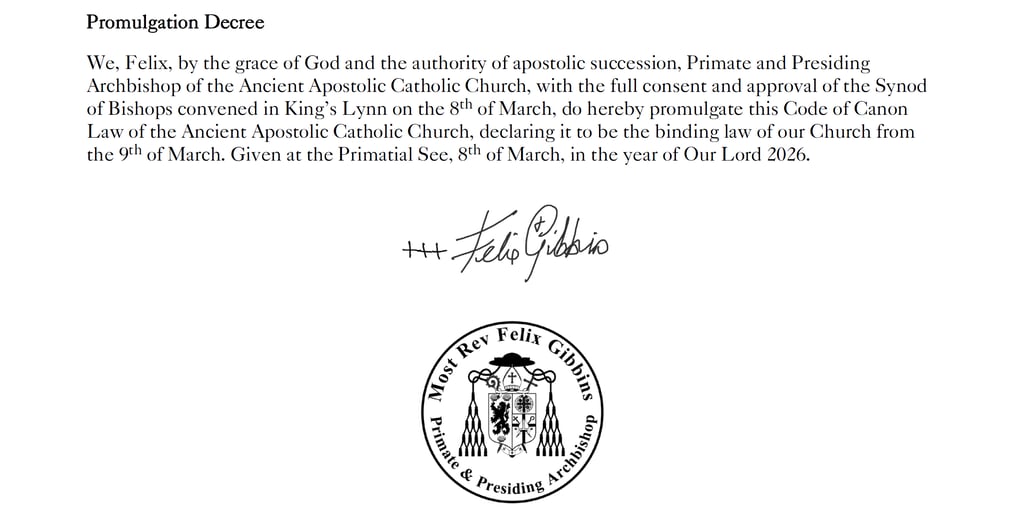
A MILESTONE IN THE LIFE OF THE CHURCH: THE PROMULGATION OF THE AACC CODE OF CANON LAW
9 February 2026 — Primatial See, St David's House, West Winch, Norfolk
Every Church that takes seriously its identity, its mission, and its pastoral responsibilities must eventually face a fundamental question: by what law do we live? For the Ancient Apostolic Catholic Church, that question has now been answered definitively. On the ninth day of February 2026, the Most Reverend Dr Felix Gibbins OSB Cam, Primate and Presiding Archbishop, formally promulgated the complete Code of Canon Law of the Ancient Apostolic Catholic Church at the Oratory of St David — an act that marks one of the most significant moments in this jurisdiction's history.
The Origins of the Project
The impetus for a dedicated Code arose from a recognition both simple and profound: a Church possessing valid apostolic succession, exercising genuine episcopal jurisdiction, and growing in membership across the United Kingdom and internationally, cannot govern itself adequately on borrowed norms and inherited assumptions alone. It requires its own body of law — one that reflects its particular identity, its conciliar governance, its liturgical breadth, and its pastoral vision.
The project began with extensive consultation between the Primate and the Synod of Bishops, drawing also on the expertise of canonists and theologians familiar with both the Roman canonical tradition and the wider history of independent Catholic jurisdictions. From the outset, the ambition was clear: to produce not a pale imitation of existing codes but a genuinely original document, rooted in two millennia of apostolic tradition yet written for the Church as it actually is today.
The Work of the Synod
The Synod of Bishops, as the supreme legislative authority of the AACC, assumed direct responsibility for the Code's development. Convening in multiple sessions over an extended period, the bishops brought to the work the full resources of their collective episcopal experience — examining each canon in turn, debating its scope and language, refining its expression, and testing it against the pastoral realities their dioceses face. Prayer undergirded every session. No canon was imposed; every provision was discerned collegially and approved unanimously.
What emerged from that process was something the bishops had hoped for but could not guarantee at the outset: a Code that is simultaneously rigorous and readable, traditional and accessible. Each canon explains not only what the Church requires but why, drawing clergy and faithful alike into the theological reasoning behind the law. This approach was deliberate. Canon law exists not as an end in itself but as a servant of the Gospel. The law serves the mission.
The Significance of Promulgation
The formal promulgation of a Code of Canon Law is no mere administrative act. It is a declaration of ecclesial maturity — a statement that this Church knows who it is, how it governs itself, how it worships, and how it cares for its members. Spanning six volumes, the Code addresses every dimension of ecclesial life: the foundations of law itself, the rights and duties of all the faithful, the sacraments, consecrated life, the stewardship of temporal goods, and the Church's system of justice and mercy.
Particularly notable is the Code's formal recognition of both the traditional Latin Mass and the modern form as equally honoured expressions of the one Roman Rite — a provision of considerable importance to the many faithful who have found in the AACC a canonical home following recent liturgical restrictions elsewhere.
The Code is now available in print through Amazon and digitally: Code of Canon Law (PDF). It belongs to every member of this Church — not as a burden, but as a gift.
Ancient Apostolic Catholic Church
Embracing faith, inclusion, and compassionate service together.
ST THOMAS AQUINAS SEMINARY
© 2026. All rights reserved
QUICK LINKS
Prayer Requests
Mass Intentions
Requiem Mass
Contact Us
Pilgrim Chronicles
ORDER OF ST DAVID
ORDER OF THE KNIGHTS OF ST MARY OF BETHLEHEM