Pope Leo XIV Confronts the Orwellian Assault on Truth
The AACC stands unreservedly with Pope Leo XIV in this prophetic witness against ideological distortion. Though we differ with Rome on certain matters of governance and liturgy, we share the same faith, the same Scriptures, the same commitment to proclaim the Gospel without apology.
FAITH DISCUSSIONSNEWS
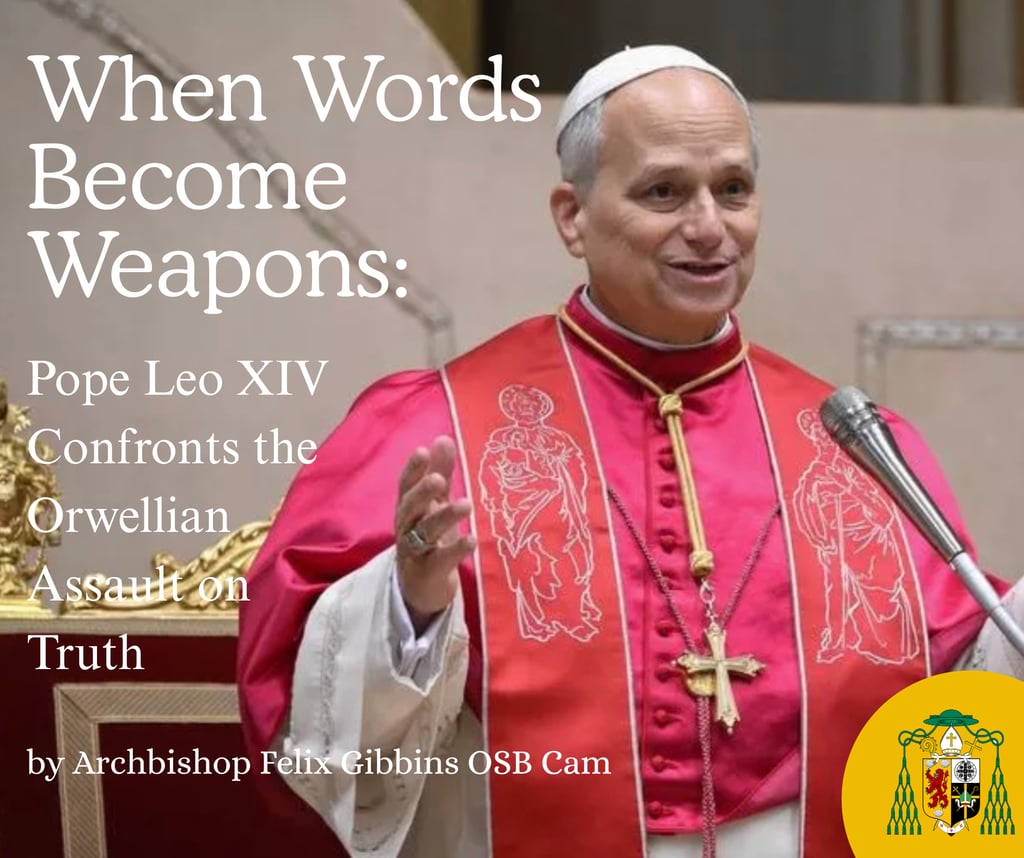
When Words Become Weapons: Pope Leo XIV Confronts the Orwellian Assault on Truth,
by The Most Reverend ✠ ✠ ✠ Felix Gibbins OSB Cam
Pope Leo XIV has done something remarkable. In his first State of the World address to the diplomatic corps on 9 January 2026, the Holy Father named what millions of ordinary people have felt but struggled to articulate: that we are living through an unprecedented assault on language itself, and that this assault is not accidental but ideological.
"It is painful to see how, especially in the West, the space for genuine freedom of expression is rapidly shrinking," the Pope declared. "At the same time, a new Orwellian-style language is developing which, in an attempt to be increasingly inclusive, ends up excluding those who do not conform to the ideologies that are fuelling it."
These are fighting words from the Bishop of Rome, and the world has taken notice. Clipped footage of the address amassed millions of views online within 24 hours. For those exhausted by years of linguistic manipulation, the Pope's intervention felt like oxygen.
The Heart of the Problem
What Pope Leo identified is not merely a cultural irritation but a fundamental crisis of truth. "Rediscovering the meaning of words is perhaps one of the primary challenges of our time," he stated. "When words lose their connection to reality, reality itself becomes debatable and ultimately incommunicable."
This is the Orwellian nightmare made real. George Orwell's Nineteen Eighty-Four depicted a totalitarian regime that controlled thought by controlling language. "Newspeak" was designed to shrink the vocabulary available to citizens until dissent became literally unthinkable. If you cannot name tyranny, you cannot resist it. If you cannot speak truth, you cannot live by it.
Today's linguistic revolution operates with similar precision but greater subtlety. It does not announce itself as propaganda. It presents itself as progress. It claims to expand inclusion whilst systematically excluding anyone who declines to participate in its redefinitions. As the Pope observed, the paradox is that "this weakening of language is often invoked in the name of freedom of expression itself."
The Assault on Reality
The Pope's reference to Orwellian language is, as commentators have noted, a thinly veiled critique of the chaos unleashed by gender ideology. When "woman" can mean anything, it means nothing. When "mother" becomes "birthing person," we have not expanded our vocabulary but abolished a concept. When medical professionals are required to affirm that biological males can become pregnant, we have entered a realm where language has been severed from reality entirely.
But the assault extends further. Pope Leo drew an explicit connection between this linguistic manipulation and the promotion of what he termed "anti-life issues." Abortion becomes "reproductive healthcare." The killing of the elderly and infirm becomes "death with dignity." Surrogacy, which the Pope condemned as reducing children to "products" and exploiting mothers' bodies, is rebranded as "family building."
"Abortion cuts short a growing life and refuses to welcome the gift of life," the Pope stated plainly. The Holy See, he added, "expresses deep concern about projects aimed at financing cross-border mobility for the purpose of accessing the so-called 'right to safe abortion.'" Notice the precision of that phrase: "so-called right." The Pope refuses to accept the ideological framing. There is no right to take innocent human life, no matter what euphemism is employed.
The Silencing of Christians
Most striking was the Pope's direct address of Christian persecution in the West. "We must not forget a subtle form of religious discrimination against Christians, which is spreading even in countries where they are in the majority, such as in Europe or the Americas," he warned. "There, they are sometimes restricted in their ability to proclaim the truths of the Gospel for political or ideological reasons, especially when they defend the dignity of the weakest, the unborn, refugees and migrants, or promote the family."
This is the reality faced by countless Christians today. Speak what Scripture teaches about marriage, and you risk professional ruin. Decline to use ideologically mandated pronouns, and you may lose your livelihood. Express the Church's teaching on the sanctity of life, and you will be labelled hateful, bigoted, dangerous.
The Pope named this for what it is: not merely cultural disagreement but the restriction of fundamental human rights. "The right to freedom of expression, freedom of conscience, religious freedom and even the right to life are being restricted in the name of other so-called new rights," he declared, "with the result that the very framework of human rights is losing its vitality and creating space for force and oppression."
The Defence of Conscience
Pope Leo offered a robust defence of conscientious objection, noting that it "allows individuals to refuse legal or professional obligations that conflict with moral, ethical or religious principles deeply rooted in their personal lives." He cited specific examples: "the refusal of military service in the name of non-violence, or the refusal on the part of doctors and healthcare professionals to engage in practices such as abortion or euthanasia."
"Conscientious objection is not rebellion, but an act of fidelity to oneself," the Pope insisted. This is a profound statement. In an age that demands ideological conformity, the simple act of following one's conscience becomes an act of courage. When the state or professional bodies demand that individuals participate in what they believe to be evil, refusal is not defiance but integrity.
"A truly free society does not impose uniformity but protects the diversity of consciences, preventing authoritarian tendencies and promoting an ethical dialogue that enriches the social fabric," Pope Leo stated. The irony is thick: those who trumpet "diversity" as their supreme value are the same forces demanding absolute uniformity of thought.
A Challenge to International Bodies
In a marked departure from his predecessor's more conciliatory approach to international organisations, Pope Leo issued a direct challenge to the United Nations. While acknowledging the UN's historic role in mediating conflicts and promoting development, the Pope called for the organisation to be "more focused and efficient in pursuing policies aimed at the unity of the human family instead of ideologies."
The implication is clear: current UN policies, particularly those promoting access to abortion and contraception, serve ideology rather than humanity. The Holy See "expresses deep concern" about international projects financing abortion access. The Pope "considers it deplorable that public resources are allocated to suppress life, rather than being invested to support mothers and families."
This tone marks a significant shift. Pope Francis entered into numerous partnerships with the UN and subsidiary bodies, partnerships that sometimes required the Vatican to mute its voice on contested moral questions. Pope Leo appears unwilling to purchase access at that price. If closer relations with international bodies require silence on abortion, euthanasia, and the family, those relations will not be pursued.
Truth Anchors Language
At the philosophical heart of the Pope's address lies a crucial insight: "Freedom of speech and expression is guaranteed precisely by the certainty of language and the fact that every term is anchored in the truth."
This is the key to understanding why the manipulation of language is so dangerous. Freedom requires truth. If words can mean anything, they mean nothing. If reality itself becomes "debatable and ultimately incommunicable," as the Pope warned, then genuine human encounter becomes impossible. We become, in St Augustine's vivid image which the Pope quoted, like two people forced to live together without sharing a language, unable to communicate, isolated in incomprehension.
The Christian faith has always understood that truth sets us free. "You will know the truth, and the truth will make you free," Christ promised (John 8:32). Conversely, falsehood enslaves. When we are required to affirm what we know to be false, we are not liberated but degraded. Our dignity as rational beings, created in the image of a God who is Logos, Word, Reason itself, is violated.
The Church's Response
What should the Church's response be to this ideological assault? Pope Leo offered his answer in his invocation of his namesake, Leo XIII, who in the face of the industrial revolution articulated a distinctively Catholic vision for society. "Much as his namesake Leo XIII did in the face of the industrial revolution of his time," one commentator noted, Leo XIV "seeks to offer a Catholic response" to the digital age's manipulation of truth.
That response begins with clarity. The Church must speak plainly. Abortion is killing. Marriage is between a man and a woman. Men cannot become women. These are not opinions but realities. The Church does the world no favours by softening its language to accommodate prevailing sensibilities. When language becomes "mushy," as one analyst put it, "conscience and freedom are easier to pressure, and the weak are easier to discard."
But clarity must be paired with courage. Pope Leo's speech was delivered to 184 ambassadors representing the world's powers. He knew his words would be reported, analysed, criticised. He spoke them anyway. This is the model for all Christians. We must speak the truth in love, but we must speak it.
A Word of Support
The Ancient Apostolic Catholic Church stands unreservedly with Pope Leo XIV in this prophetic witness against ideological distortion. Though we differ with Rome on certain matters of governance and liturgy, we share the same faith, the same Scriptures, the same commitment to proclaim the Gospel without apology.
The defence of truth is not a partisan cause. It is a Christian duty. When language is manipulated to obscure evil and silence good, Christians of all traditions must speak. When international bodies promote death under the guise of "rights," the Church must object. When believers are penalised for living according to Scripture, we must stand with them.
Pope Leo has shown what courageous witness looks like. May all Christians take note, take heart, and take courage.
In the words of the Prophet Isaiah: "Woe to those who call evil good and good evil, who put darkness for light and light for darkness" (Isaiah 5:20). That ancient warning has never been more timely. The ideological manipulation of language is precisely the calling of evil good. Pope Leo has named it. Now the Church must resist it.
†
Pax et Bonum
✠ ✠ ✠ Felix Gibbins OSB Cam
Primate and Presiding Archbishop
Ancient Apostolic Catholic Church
January 2026
Ancient Apostolic Catholic Church
Embracing faith, inclusion, and compassionate service together.
ST THOMAS AQUINAS SEMINARY
© 2026. All rights reserved
QUICK LINKS
Prayer Requests
Mass Intentions
Requiem Mass
Contact Us
Pilgrim Chronicles
ORDER OF ST DAVID
ORDER OF THE KNIGHTS OF ST MARY OF BETHLEHEM