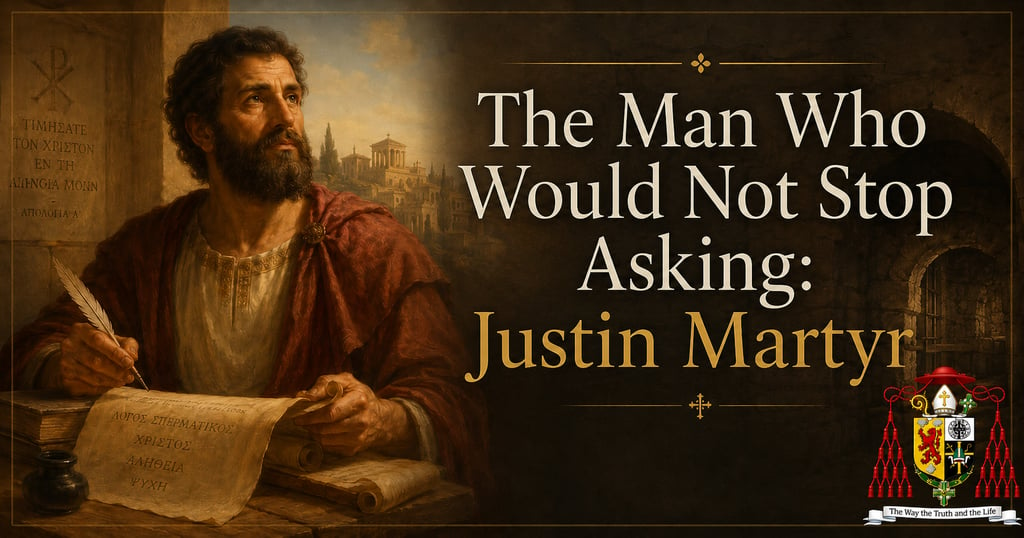
St Justin Martyr: The Man Who Wouldn't Stop Asking
Justin was a man who could not stop asking questions. And God, it turns out, was not bothered by that at all. He was born around the year 100 in Samaria, into a pagan family
SAINTS
A Reflection on St Justin Martyr
Justin was a man who could not stop asking questions. And God, it turns out, was not bothered by that at all.
He was born around the year 100 in Samaria, into a pagan family, and from early on he was drawn to philosophy the way some people are drawn to water. Not for entertainment. Because he needed to know what was actually true. He worked his way through the Stoics, the Pythagoreans, the Platonists. Platonism came closest, because it pointed beyond the visible world toward something greater. But it could not get him there.
What changed everything was a conversation on a beach with an old man he had never met before and never met again. The man asked Justin where philosophy had actually taken him. Had it brought him to God? Could reason alone do that? Then he directed Justin toward the Hebrew prophets, men who had seen and spoken what no unaided mind could reach. And something shifted.
Justin writes about it in his Dialogue with Trypho: “A fire was suddenly kindled in my soul. I fell in love with the prophets, and with these men who had loved Christ; and while I was revolving his words in my mind, I discovered that his was the only sure and useful philosophy” (8).
Not the most elegant philosophy. Not the most sophisticated. Sure and useful. That is the language of a man who has stopped performing and started believing.
This matters for us. Many people today are doing what Justin did before that conversation. They are moving between ideas, searching, trying things on, finding that nothing quite holds. The Church does not ask us to pretend that search never happened. She asks us to follow it honestly to its end.
Abba Moses, one of the Desert Fathers, was once asked for a guiding word. He said simply: “Go, sit in your cell, and your cell will teach you everything.” It sounds sparse. But it points to the same truth Justin discovered. Stop moving. Let truth find you.
What Justin had come to understand was that the Logos, the Word that Saint John places at the very beginning of his Gospel (John 1:1), was not invented by Christians. It was revealed by them. He wrote that “whatever things were rightly said among all men are the property of us Christians” (Second Apology, 13). Wherever honest reason had reached toward truth, it was already, without knowing it, following the Word made flesh.
He continued wearing the philosopher’s cloak after his conversion. He saw no reason to take it off. Faith does not discard the mind. It brings the mind to what it was made for.
He opened schools in Rome. He wrote to emperors, laying out what Christians actually believed, at a time when that carried real risk. He was not trying to be brave. He was trying to be honest, and honesty in that world had consequences.
When he was arrested in 165, along with six companions, the record of his trial was kept. The prefect Rusticus asked him directly: “What is your doctrine?” Justin answered without any drama: “We believe in one God, maker of all things visible and invisible.” When the prefect made clear that refusal to sacrifice meant death, Justin replied that through suffering faithfully endured, they trusted to be saved by Jesus Christ, and that this confidence would stand before the judgement of God (Acts of Justin and Companions).
He was executed shortly after. He had known that was likely. He went ahead anyway.
Abba Poemen said: “Teach your mouth to say that which you have in your heart.” Justin spent his entire life doing precisely that. He thought as carefully as he could, believed as deeply as he could, and then said so, in his writing, in his teaching, and finally before the man who signed his death warrant.
He is called a martyr, which means witness. But he was a witness long before the end. Every time he wrote honestly, taught clearly, or refused to soften the truth for a more comfortable audience, he was already bearing witness.
That is the invitation his life puts to us. Not to become philosophers. To become honest. To follow the truth we find, wherever it goes, and to say what we actually believe.
That is enough. It was enough for Justin. It will be enough for us.
Ancient Apostolic Catholic Church
Embracing faith, inclusion, and compassionate service together.
ST THOMAS AQUINAS SEMINARY
© 2026. All rights reserved
QUICK LINKS
Prayer Requests
Mass Intentions
Requiem Mass
Contact Us
Pilgrim Chronicles
ORDER OF ST DAVID
ORDER OF THE KNIGHTS OF ST MARY OF BETHLEHEM