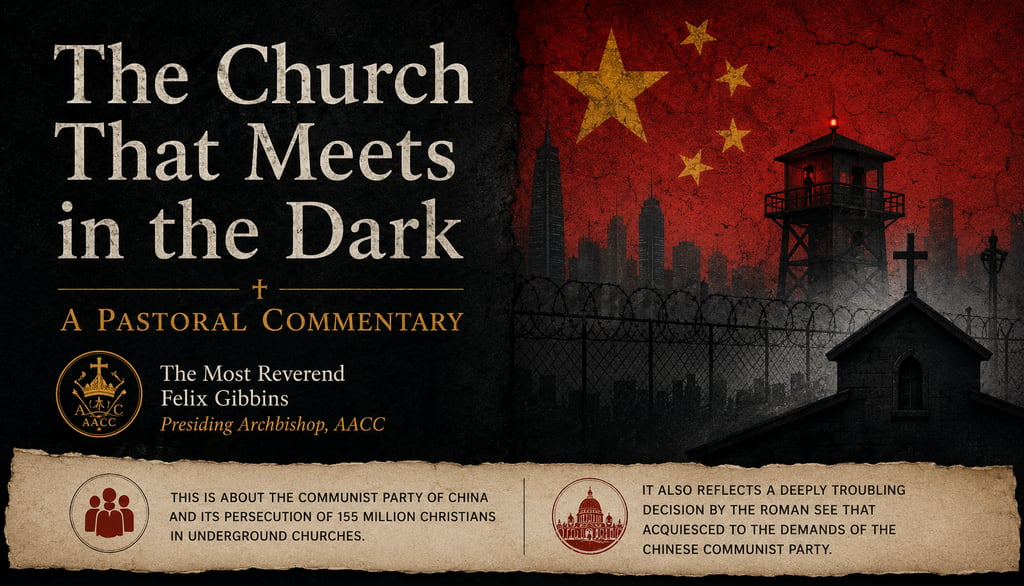
The Church That Meets in the Dark
The Chinese government will not stop its campaign against Christian belief. That is a political reality. But the Church of Jesus Christ, as Scripture and history both make clear, has survived emperors before. It has survived tyrants, edicts, persecutions, and betrayals.
REFLECTIONS
Last month a man called TJ stood completely still in his own home, his wife pressed against him, their three-year-old daughter between them, willing the noise outside to pass. The power had already been cut. The phone line dead. Then came the banging on the door. When the police broke through, they shoved his wife and daughter into a separate room and pinned TJ where he stood, hands on his clothes, hands on his arms, so he could not move. He could hear his child crying on the other side of the wall. He could do nothing. His wife was taken to a police station. She has not been released.
TJ is a Christian in China. That is what he did wrong. He worships Jesus Christ in a church that is not sanctioned by the state, which means he has broken the law. He is not a criminal. He is a man of faith raising a family, and the government of President Xi Jinping has decided that is something it cannot permit. There are other stories just like this; it’s not just TJ who has been affected.
This is not history. This is not the Cultural Revolution or the persecutions of Mao. This is happening now, in 2026, to hundreds of thousands of ordinary people whose only defiance is that they choose to follow Christ outside the boundaries the state has drawn for him.
The Scale of What Is Happening
There are an estimated 44 million Christians worshipping in state-sanctioned churches in China. But there are believed to be somewhere between 115 million and 160 million Christians who refuse to submit to government control, and who therefore worship in what are called house churches or underground churches. Some estimates place the number of unregistered Christians as high as 115 million, which could position China to have the world's largest Christian population by 2030 should it continue to grow.
We are talking about a community of believers larger than the entire population of the United Kingdom, worshipping in secret, at genuine risk to their freedom and their lives.
Major documented operations against these communities include the 2018 raids on Early Rain Covenant Church in Chengdu, where over 100 were detained and Pastor Wang Yi was later sentenced to nine years in prison for “inciting subversion of state power.” That is not a historical footnote. Wang Yi is still in prison.
In October 2025, Chinese authorities arrested nearly 30 pastors, preachers, and church members of the unofficial Zion Protestant Church across seven cities, including Beijing, Shanghai, and Zhejiang. Among those arrested was the church’s founder, Pastor Ezra Jin Mingri. The Zion Church had grown to over 40 cities across China with an estimated membership of around 10,000. It was not a small gathering of dissidents. It was a thriving community of faith.
In January 2026, police raided the home of the current leader of the Early Rain Covenant Church, Li Yingqiang, in Deyang, and took him away. Other key church members were similarly taken into custody. This was the beginning of a new year. These are people facing that new year in a cell, for no reason other than their faith.
The tactics are not simply imprisonment. The Telegraph describes police arriving at homes in the middle of the night, friends rounded up and questioned for weeks on end, loved ones convicted on charges such as “using superstition to undermine the law,” and lawyers targeted and suspended from practising for defending Christians.
One pastor, Jun Yang, was in South Korea when authorities raided his family home. His wife was arrested in front of their children. He has not spoken to her since. If he returns to China, he will be arrested. He may never see his family again.
Then there is Gao Quanfu and his wife Pang Yu, both in their late sixties, imprisoned for founding a church outside state control. Their son told the Telegraph that his father was approached many times about joining the state church and refused. His reason was simple. He called them “fake churches.” He was right.
What Xi Jinping Is Actually Doing
Let us be clear about what this is. President Xi Jinping has not launched a religious programme. He has launched a political one. In 2015, he launched a “Sinicisation” campaign, which forced all religious and ethnic groups to assimilate and prioritise loyalty to the Chinese Communist Party over individual religious belief. The same policy has been used to imprison and torture Uyghur Muslims in what many human rights organisations characterise as genocide.
The state churches are closely overseen by the government, which monitors what is preached and who is present. Under-18s are not permitted to attend. Read that again. Children are banned from church. Not from certain activities. From the building itself.
In the registered churches, congregants are expected to sing patriotic songs before every service and to display President Xi’s portrait above the altar. The cross of Christ displaced by the image of a political leader. That is not inculturation. That is idolatry enforced by law.
“It’s the emperor playing God. He wants to be exclusive. He doesn’t want to have anything treated or worshipped as more superior than him.”
— Bob Fu, founder of ChinaAid
Catholic doctrine is being actively restructured in accordance with party directives. Bishops of the state-sanctioned Catholic church have openly stated that the goal of religious work in China is to implement Xi’s directives, and that Catholicism must reflect “Chinese characteristics” – by which they mean Communist Party ideology.
This is the reality inside the official churches. And those involved in house churches are especially susceptible to hostility, particularly church leaders, with incentives offered to informants who report on so-called “illegal” religious activities. Neighbour informing on neighbour. Family members encouraged to report their own parents for praying at home. This is where we are.
A Failure of the See of Rome
I need to speak now about something that causes me genuine pain, and I choose my words with care.
In September 2018, the Holy See signed a provisional agreement with the People’s Republic of China, brokered under Pope Francis, regarding the appointment of Catholic bishops. As a precondition of the agreement, Pope Francis was willing to lift the prior excommunications of seven government-named bishops, and the agreement required the Vatican to refrain from pressing Beijing on the status of the underground Catholic Church, the ban against religion for youth, the state’s destruction of numerous churches, its efforts to reinterpret the Bible, and a host of other human rights crises.
Until the 2018 agreement, the Vatican’s church in China was underground and Beijing-appointed bishops were subject to excommunication. That position had a theological coherence. It said, simply: you cannot have a bishop appointed by an atheist state without reference to Christ’s Church. There is a logic to that, and it is right. The 2018 agreement reversed that position.
Cardinal Joseph Zen Ze-kiun, the Bishop Emeritus of Hong Kong, called it plainly what it was. He told Reuters: “They’re sending the flock into the mouths of the wolves. It’s an incredible betrayal. The consequences will be tragic and long-lasting, not only for the church in China but for the whole church because it damages the credibility.”
He was right. After the agreement was signed, Chinese authorities rounded up underground Catholic clergy, warning that they would defy the pope if they continued baptising, ordaining new clergy, and praying in unregistered churches. The agreement, intended to bring unity, was weaponised against the very people it claimed to protect.
The Vatican accepted that the agreement would “exclusively concern” episcopal appointments, and the power of appointment would rest in the hands of the Chinese Communist Party, whose consistent policy goal has been the extinction of religion. That is the assessment of serious scholars. The Chinese state’s goal is not to manage religion. It is to eliminate it.
The Vatican has never exercised its veto power, even when the Chinese government violated the agreement by unilaterally appointing bishops in 2022 and 2023 – appointments that Pope Francis later accepted. When Pope Francis died in April 2025, the CCP moved immediately to appoint two new bishops during the mourning period before a new pope had even been elected. The Chinese government did not grieve. It saw an opportunity.
Now we have Pope Leo XIV. I hold genuine hope for this pontificate, and I pray for him regularly. But the signs so far give me cause for concern as well as for prayer. One year into his pontificate, Leo XIV continues to maintain a prudent silence on one of the most sensitive cases inherited from his predecessor. The pact remains secret, and voices are growing that warn of the risk that Vatican diplomacy will end up sacrificing the freedom of the Chinese underground Church in the name of a dialogue that Beijing seems to use mainly to reinforce its control over Catholicism.
Human Rights Watch has urged Pope Leo XIV to demand an urgent review of the agreement and press for the release of imprisoned clergy before the deal comes up for renewal in 2028.
I add my voice to that call. But I go further.
The agreement has failed on its own terms. It has not brought freedom. It has not brought unity in any meaningful theological sense. What it has brought is cover for a state that uses the word “Catholicism” whilst systematically dismantling every principle the Catholic faith holds sacred.
What This Demands of Us
I want to speak now to those of us in the West, because this is where I feel something close to anger.
We live in countries where we can walk into a church on a Sunday morning and no one will break down our door. We can preach the Gospel, teach our children the faith, receive the sacraments, and go home to our families. And so many of us treat it as optional. Inconvenient. Something to be fitted around sport or leisure or a Sunday lie-in.
The men and women in China’s underground churches have written farewell letters before their gatherings. They have said goodbye to their children, not knowing if they will return. They gather anyway. They baptise in secret. They ordain in secret. They hold the Eucharist in secret. They do it because Jesus Christ is Lord, and no government decree can change that.
In the Acts of the Apostles we read of the earliest believers that they “continued steadfastly in the apostles’ doctrine and fellowship, in the breaking of bread and in prayers” (Acts 2:42). That is what we call the Church. That is what these people are doing. And they are doing it at a cost we in the West can barely begin to imagine.
One Chinese Christian said to Open Doors: “Some of us have written farewell letters. We’ve prepared for prison. We’ve chosen to follow Christ through any storm.” I find it genuinely difficult to read those words without feeling ashamed of how lightly I have sometimes treated my own faith, my own calling, my own vocation.
Saint Paul, writing from a prison cell to the Philippians, said: “I have learned, in whatever state I am, to be content… I can do all things through Christ who strengthens me” (Philippians 4:11, 13). Paul knew imprisonment. He knew persecution. He wrote those words not as inspirational sentiment but as lived truth. The Christians of China’s underground churches are living that same truth today.
A Call to Prayer
I am asking you to pray. Not in a vague, passing way. Specifically and persistently.
Pray for TJ, whose wife remains in detention, whose daughter cried behind a closed door. Pray for Jun Yang, separated from his wife and children. Pray for the elderly couple, Gao Quanfu and Pang Yu, in prison in their late sixties. Pray for Pastor Wang Yi, still serving nine years. Pray for the leaders of Zion Church and Early Rain Covenant Church, detained in January of this year.
Pray for the millions who meet tonight in homes and basements and fields, who gather in the name of Jesus Christ knowing the risk they are taking. Pray that God will guard them, strengthen them, and confound their persecutors.
And pray for Pope Leo XIV. I believe he has the capacity to do the right thing. History will record whether he found the will to do it. I am praying that he will have the courage to revisit the decisions of his predecessor, to withdraw the Vatican from an arrangement that has demonstrably served the interests of the Chinese Communist Party rather than the people of God. I am praying that he will act in the spirit of Saint John Paul II, who in the year 2000 canonised 120 martyrs killed in China despite fierce protest from Beijing. John Paul did not negotiate with Caesar over the saints. I am praying that Leo XIV finds that same clarity – and that he will once again move to excommunicate the bishops of the state-sponsored church who have placed the Party above the Gospel and the state above God.
“Better no deal than a bad deal.”
— Cardinal Joseph Zen Ze-kiun, Bishop Emeritus of Hong Kong
He was right in 2018. He is still right.
The Chinese government will not stop its campaign against Christian belief. That is a political reality. But the Church of Jesus Christ, as Scripture and history both make clear, has survived emperors before. It has survived tyrants, edicts, persecutions, and betrayals. What it requires from us, in our comfortable Western freedom, is not silence. It requires solidarity. It requires prayer. It requires the willingness to stand up and say that what is being done to these people is wrong, that it is evil, and that the Church of God will not pretend otherwise.
We are members of one body. When one part suffers, all suffer with it (1 Corinthians 12:26). Our brothers and sisters in China are suffering. The least we owe them is our prayers, our voices, and our refusal to look away.
Ancient Apostolic Catholic Church
Embracing faith, inclusion, and compassionate service together.
ST THOMAS AQUINAS SEMINARY
© 2026. All rights reserved
QUICK LINKS
Prayer Requests
Mass Intentions
Requiem Mass
Contact Us
Pilgrim Chronicles
ORDER OF ST DAVID
ORDER OF THE KNIGHTS OF ST MARY OF BETHLEHEM