The Hours That Hold You - The Liturgy of the Hours
When you pray the Hours, you are not bringing your own agenda to God and asking him to attend to it. You are stepping into a prayer that is already happening, that has been happening continuously across the Church for centuries, and you are joining it.
PRAYER
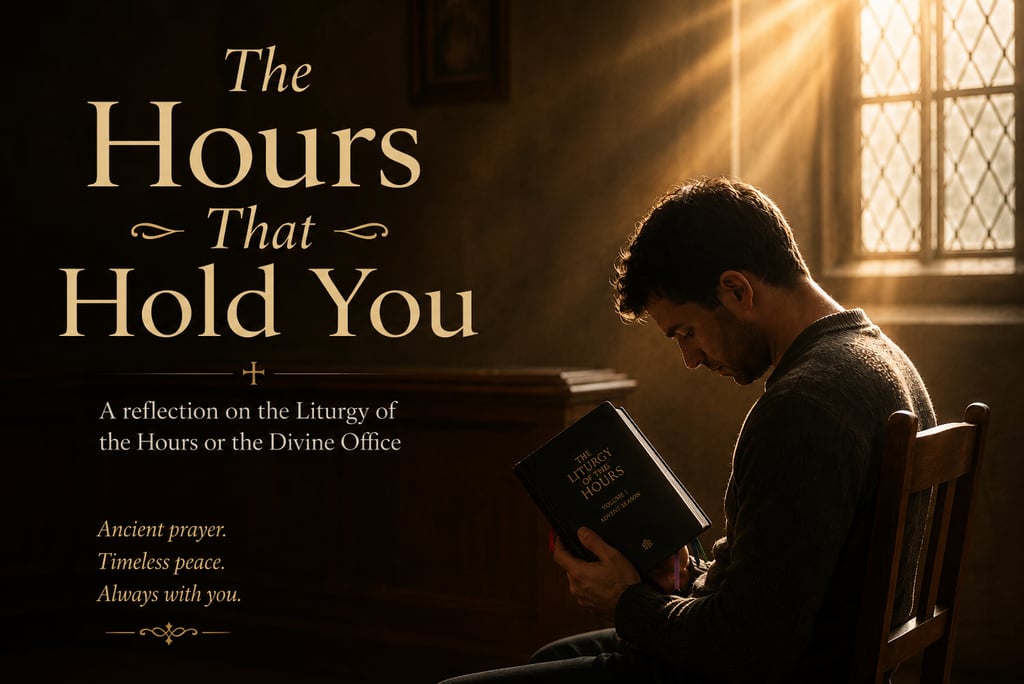
The Hours That Hold You - A Reflection on the Liturgy of the Hours
Most people, when they think about prayer, think about something they initiate. They find a quiet moment, they bring their concerns to God, they speak or they sit in silence. And that is real prayer. But the Liturgy of the Hours is something different in kind, not just in form.
When you pray the Hours, you are not bringing your own agenda to God and asking him to attend to it. You are stepping into a prayer that is already happening, that has been happening continuously across the Church for centuries, and you are joining it. The Church prays Morning Prayer as the sun rises somewhere in the world. Evening Prayer as the light fades somewhere else. Compline as communities settle into night silence. You add your voice to that, and something shifts.
It is worth understanding where this comes from. The Hours are rooted in the ancient Jewish practice of set times for prayer, the same rhythm that shaped the life of Jesus himself. The psalms that form the backbone of the Hours were the prayers he prayed. When you open the psalter and pray Psalm 63, “O God, you are my God, for you I long” (Psalm 63:1), you are not simply reading a poem. You are praying with Christ, in the words he knew by heart, in the pattern his own days were shaped by.
Now, if you have never tried the Hours, the thought of the full Divine Office can feel overwhelming. Seven distinct prayer times, Latin antiphons, complex rubrics. Leave all of that to one side for a moment. Because the invitation is simpler than that. Morning Prayer and Evening Prayer, Lauds and Vespers, are the twin hinges of the day. Begin there. Even one of them, prayed regularly, will begin to do something in you.
What does it do? This is harder to put into words, but let me try. Personal prayer flows from where we are on a given day. If we are anxious, our prayer tends to be anxious. If we are distracted, it tends to be scattered. The Liturgy of the Hours does not wait for us to arrive in a particular interior state. It simply begins. And gradually, sometimes slowly, it pulls us out of ourselves and into something larger. The psalms will give you language for emotions you did not know you were carrying. They will hand you words of praise on days when praise feels impossible. They will anchor you in the story of God’s faithfulness when your own circumstances feel anything but faithful.
The Holy Spirit moves through this in a way that is genuinely its own. There will be mornings when a line from a psalm lands with a weight you cannot account for, when a verse from a canticle opens something in your understanding that no amount of personal reflection had reached. That is not coincidence. The Church has always understood the Liturgy of the Hours as the prayer of the whole Body of Christ, and where the Body prays, the Spirit is present and active.
St Paul writes in his letter to the Ephesians, “be filled with the Spirit, addressing one another in psalms and hymns and spiritual songs” (Ephesians 5:18-19). The Hours are precisely that. They are the Church addressing God, and God addressing the Church, in the language of Scripture, day after day, season after season.
You do not need to be a monk or a nun to enter this. You need a text, a little time, and a willingness to show up. The prayer will meet you where you are. And over time, quietly and without drama, it will begin to change where you are.
Start with one Hour. See what God does with it.
Ancient Apostolic Catholic Church
Embracing faith, inclusion, and compassionate service together.
ST THOMAS AQUINAS SEMINARY
© 2026. All rights reserved
QUICK LINKS
Prayer Requests
Mass Intentions
Requiem Mass
Contact Us
Pilgrim Chronicles
ORDER OF ST DAVID
ORDER OF THE KNIGHTS OF ST MARY OF BETHLEHEM