Reading Scripture with the Church
The Four Senses of Scripture: A Teaching Resource - These four senses are not a checklist to be worked through mechanically. They are, at their best, a way of standing before the Word of God with the full attention of the mind
BIBLE STUDIES
Reading Scripture with the Church
The Four Senses of Scripture: A Teaching Resource
Introduction: The Bible Is Not a Flat Book
If you have ever opened the Bible and felt that you were missing something, you were right. Not because the text is obscure or scholars have kept secrets from you, but because the Catholic tradition has always understood Scripture to be a layered reality, a living word that operates on multiple levels at once. The four senses of Scripture, which the Church has taught and practised for nearly two millennia, are among the most intellectually exciting and spiritually nourishing gifts in the Catholic inheritance. They explain why Catholics read the Bible differently from fundamentalists, why the Old Testament matters at Mass, and why a passage you have heard a hundred times can still surprise you.
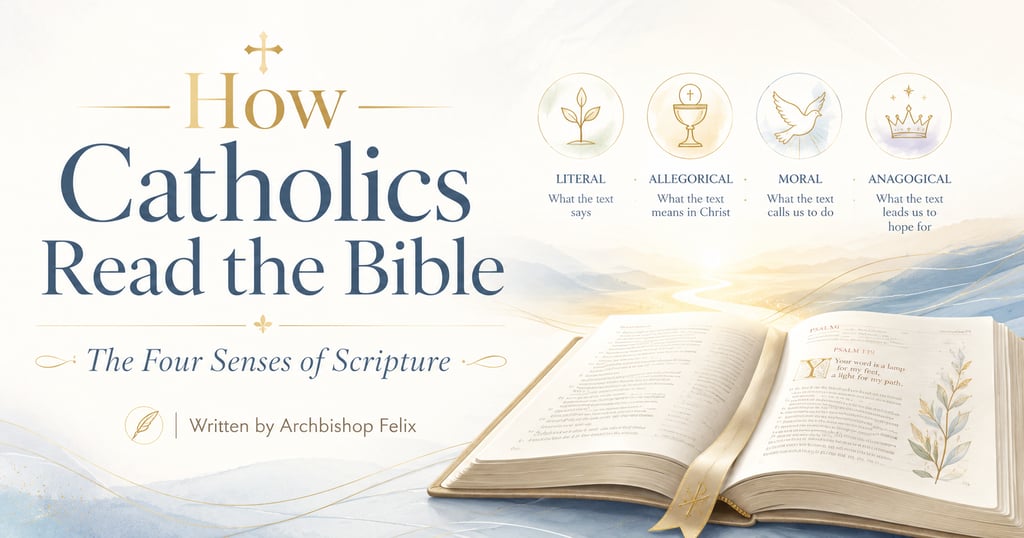
The four senses are the literal, the allegorical, the moral (or tropological), and the anagogical. They are not competing interpretations, nor are they a way of escaping what the text actually says. Rather, they are four distinct windows that open onto the same sacred reality. The Catechism of the Catholic Church teaches clearly: "The different senses of Scripture must be distinguished, and then synthesised" (CCC 115). The Church does not invite us to choose one and ignore the others. She invites us into all four, in sequence, as a movement of ever-deepening encounter with the Word of God.
"According to an ancient tradition, one can distinguish between two senses of Scripture: the literal and the spiritual." (CCC 115)
The First Sense: The Literal
What the text actually says, and why that matters enormously
The literal sense is the foundation on which everything else is built, and it is far more demanding than it might appear. To read Scripture literally is not to read it naively. It is to ask, with genuine scholarly and prayerful attention, what the human author intended to communicate, in the genre, the culture, the historical moment in which he wrote. The Church has never taught that Genesis reads like a scientific textbook, or that the psalms of lament describe meteorological events. Literary genre matters. Historical context matters. The literal sense is, as Saint Thomas Aquinas expressed it, the meaning which the author intends, and that intention must be understood on its own terms.
This is why Catholic engagement with Scripture has never been threatened by historical-critical scholarship in the way that a certain strand of Protestant fundamentalism has been. When archaeologists excavate Jericho, or when scholars debate the authorship of Isaiah, Catholics can engage with those conversations without existential anxiety, because the literal sense is not the only sense, and the truth of Scripture is not exhausted by what can be verified on the ground. The literal sense is the anchor. It keeps us honest. It prevents the allegorical and spiritual senses from floating away into arbitrary fantasy. But it is never the ceiling.
A point worth making to a group: when Jesus tells the parable of the Prodigal Son, the literal sense is that he is telling a story about a father, two sons, and a homecoming. He is not describing a historical event. But the literal sense of a parable is still the literal sense, because parables are a literary genre, and the author intends to be understood as telling a parable. Reading it as a literal account of something that happened would actually be a misreading of the literal sense. This subtlety is worth dwelling on, because it challenges the assumption that "literal" means "factual in the way a news report is factual."
The Second Sense: The Allegorical
How the Old Testament reveals Christ, and why this transforms everything
The allegorical sense is where Catholic biblical reading becomes, for many people, a moment of genuine wonder. It is the sense in which events, persons, and institutions in Scripture are understood to foreshadow, prefigure, or point towards Christ and his Church. The technical term for this is typology, and it has been central to Christian reading of the Bible from the very beginning.
Saint Paul was already doing it in the first century. Writing to the Corinthians, he tells them that the Israelites who passed through the Red Sea were "baptised into Moses in the cloud and in the sea" (1 Cor 10:2), and that the rock from which they drank in the desert "was Christ." He was not inventing a private interpretive method. He was applying the logic that Jesus himself had introduced when he said that the Son of Man must be lifted up "just as Moses lifted up the serpent in the desert" (John 3:14), or when he declared that "something greater than the Temple is here" (Matt 12:6).
Every crossing, every sacrifice, every covenant in the Old Testament is, for the allegorical reading, a doorway through which Christ is glimpsed
The sacrifice of Isaac on Mount Moriah is not only the story of Abraham's obedience and God's provision: it is a prefiguring of the Father offering the Son, and of the Son carrying his own cross up the hill. The Passover lamb, slaughtered and its blood smeared on the doorposts, is not only a memory of liberation from Egypt: it is the lamb of God whose blood marks the threshold between death and life. The crossing of the Jordan into the Promised Land prefigures baptism, the entry into new life in Christ. The Temple, built by Solomon as the dwelling place of God among his people, prefigures the body of Christ, who declares "destroy this temple and in three days I will raise it up" (John 2:19).
This is why the Church reads the Old Testament at Mass without embarrassment or apology. It is not simply historical background. It is the story of which Christ is the fulfilment. The allegorical sense does not diminish the Old Testament: it reveals its innermost meaning. And it transforms the New Testament as well, because every action of Jesus becomes richer when we understand what it recapitulates and fulfils.
The Third Sense: The Moral (Tropological)
What Scripture demands of us, and why reading is never merely academic
The moral sense, sometimes called the tropological sense from the Greek word for "turn," is the sense that asks what Scripture requires us to do. It reads the sacred text as a call to conversion, to action, to the transformation of life. It is the sense that refuses to let us remain passive before the Word of God.
When the Good Samaritan crosses the road to care for the man beaten and left for dead, the moral sense does not allow us simply to admire the story. It puts a question to us directly: who is your neighbour, and are you crossing the road? When the prophet Amos thunders against those who "sell the righteous for silver and the needy for a pair of sandals" (Amos 2:6), the moral sense asks whether we are complicit in the same structures of injustice in a different age. When Jesus washes the feet of his disciples and says "I have given you an example, that you also should do as I have done" (John 13:15), the moral sense is not subtle: it is explicit, direct, and demanding.
It is worth noting that the moral sense is not the same as moralising. It does not reduce Scripture to a list of ethical rules. It reads the whole sweep of salvation history as a pattern of divine love calling forth a human response. The moral sense of the Exodus, for instance, is not merely "obey God and he will rescue you." It is the deeper invitation to understand that liberation from slavery is always God's will, that he is always on the side of the poor and the captive, and that his people are called to embody that same preferential love in the world.
For a teaching group, this sense is often the one people are most comfortable with, and perhaps the one they most need to be challenged on. It is easy to read Scripture morally in a self-confirming way, finding in the text permission for what we already believed. The genuine moral sense is more uncomfortable than that. It reads us as much as we read it.
The Fourth Sense: The Anagogical
The vision of heaven, and why eternity changes how we read everything
The anagogical sense is the least familiar to modern readers, and perhaps the most transformative once it is grasped. It comes from the Greek word for "leading upward," and it reads Scripture in the light of its ultimate destination: the Kingdom of God, the resurrection of the dead, the new creation, the beatific vision. Every text, for the anagogical reader, is oriented towards eternity, and the whole of human history is understood as a movement towards its final fulfilment in God.
The Catechism offers a memorable example. Jerusalem, in the literal sense, is a city in the ancient Near East, the capital of David's kingdom and the site of the Temple. In the allegorical sense, it is the Church, the community gathered in Christ. In the moral sense, it is the soul, the interior life ordered towards God. In the anagogical sense, it is the heavenly Jerusalem, the city of God that is to come, the eschatological reality towards which all worship, all prayer, all sacramental life is moving (CCC 117).
In the anagogical sense, even the smallest detail of Scripture opens onto an infinite horizon.
This sense helps to explain why the Book of Revelation, so often misread as a political code for predicting current events, is in fact a sustained meditation on the liturgy of heaven breaking into the liturgy of earth. When John sees the Lamb standing as though slain, when he hears the elders casting their crowns before the throne, when the altar of incense rises before the face of God, he is describing the eternal dimension of what the Church does every time she gathers to celebrate the Eucharist. The anagogical sense holds together the Mass and the End, the present moment and the eternal one, in a single vision.
For those who grieve, who struggle, who find themselves in what can only be described as the dark night of the soul, the anagogical sense is not an escape from suffering: it is the assurance that suffering is not the last word. The psalms of lament, read anagogically, are not simply expressions of ancient misery. They are the prayer of every human heart that has ever cried out to God from the depths, and they carry within them the seed of a joy that no present circumstance can extinguish.
Reading as Pilgrimage: The Four Senses Together
These four senses are not a checklist to be worked through mechanically. They are, at their best, a way of standing before the Word of God with the full attention of the mind, the memory, the will, and the hope. The medieval scholars who systematised them were not building an academic framework for its own sake. They were trying to honour the inexhaustible richness of a text that they understood to be, in its deepest nature, the speech of God addressed to his people across time.
The literal sense grounds us in history and in the humanity of the biblical authors. The allegorical sense opens us to Christ as the centre and fulfilment of all that went before. The moral sense calls us out of passive reading into active discipleship. The anagogical sense lifts our eyes beyond the present moment to the horizon of eternity. Together, they form a movement of reading that is at once intellectual and contemplative, demanding and consoling, rooted in the particular and open to the universal.
When a congregation hears Isaiah's Suffering Servant at the Good Friday liturgy, all four senses are in play simultaneously. The literal sense attends to what the prophet wrote and what he meant in his own time and context. The allegorical sense recognises in the Servant the Christ who is about to be crucified. The moral sense asks what it means for us to take up our cross and follow him into that self-offering. The anagogical sense holds before us the resurrection that is the answer to the cross, the glory that follows the suffering, the eternal life that is the meaning of the death.
People who discover this way of reading the Bible frequently describe it as a kind of homecoming. They have always sensed that Scripture was deeper than it appeared. The Church's tradition gives them the tools, and the permission, to go further in.
Group Discussion Questions
For use in RCIA, Bible study, faith formation groups, or clergy preparation
The following questions are designed to open conversation rather than close it. They may be used sequentially across several sessions, or selectively according to the group's focus and experience.
On the Literal Sense
Before today, how did you think about "reading the Bible literally"? Has that understanding shifted at all, and if so, how?
Can you think of a passage in Scripture where paying attention to literary genre (poetry, prophecy, parable, letter) changes how you read it?
Why do you think the literal sense has to be the foundation before the other senses can be explored?
On the Allegorical Sense
Which Old Testament "type" or prefigurement of Christ do you find most striking or moving? Why?
How does the allegorical sense change the way you hear the Old Testament readings at Mass?
Is there a danger in allegorical reading? How does the Church guard against interpretations that become too fanciful or arbitrary?
On the Moral Sense
Think of a passage you have read many times. What does the moral sense require of you personally, right now, in your present circumstances?
How is the moral sense of Scripture different from simply using the Bible to confirm what we already believe?
Can you think of a moment when Scripture genuinely challenged you to change something in your life? What sense of the text was operating there?
On the Anagogical Sense
The anagogical sense reads every text in the light of eternity. How does this change the way you might read a passage about suffering or loss?
How does understanding the anagogical sense affect the way you participate in the liturgy, particularly the Mass?
What would it mean, in practice, to read Scripture with eternity in view every day?
Bringing It Together
Which of the four senses is most natural for you, and which is most challenging? What might that tell you about where you are in your spiritual journey?
How might you use the four senses in your own daily prayer with Scripture, perhaps when reading the Office or a lectionary passage?
If you were to explain the four senses to someone who had never heard of them, what image or analogy would you use?
Ancient Apostolic Catholic Church
Embracing faith, inclusion, and compassionate service together.
ST THOMAS AQUINAS SEMINARY
© 2026. All rights reserved
QUICK LINKS
Prayer Requests
Mass Intentions
Requiem Mass
Contact Us
Pilgrim Chronicles
ORDER OF ST DAVID
ORDER OF THE KNIGHTS OF ST MARY OF BETHLEHEM